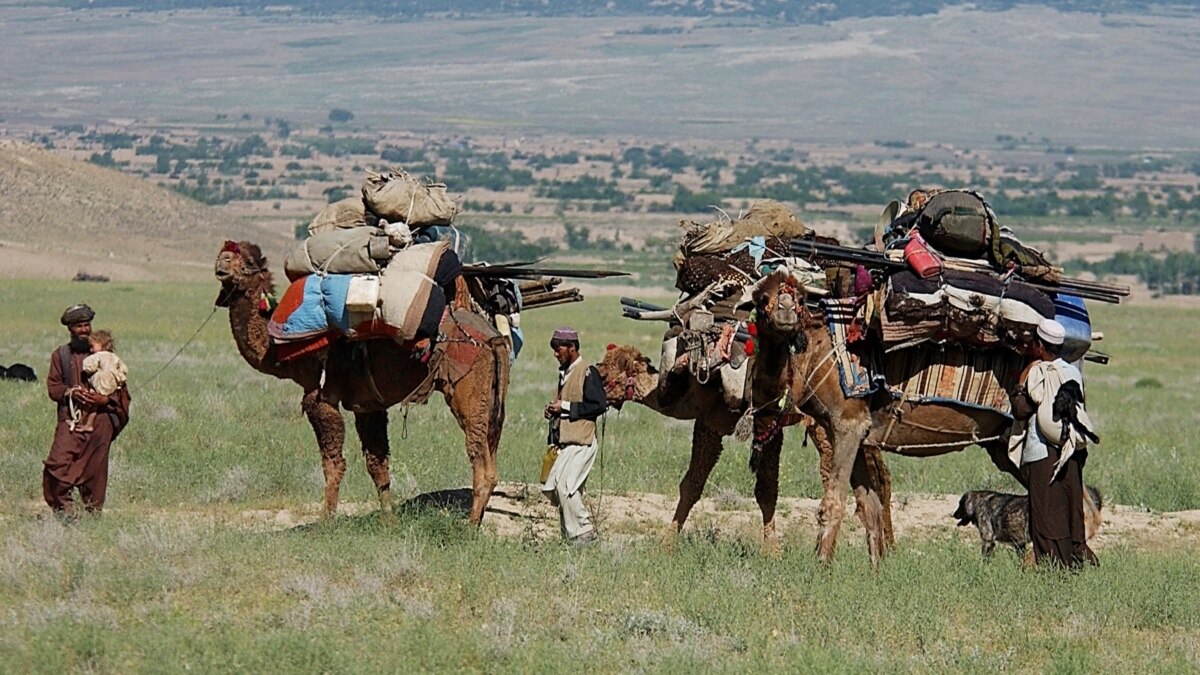
Residents of the districts along the Kokcha River (Dasht Qala, Rustaq, Yengi Qala, Darqad, Chah Aab and Khwaja Bahauddin) in Takhar province report that during the course of the last year, about 700 Kuchi families – Pashtun Nomads – have been settled in Khwaja Bahauddin and Dasht Qala districts.
The nomads that come from Pakistan have settled in the villages of Lala Guzar, Katkajar, Baharistan and Moghul Qashlaq in Khwaja Bahauddin district and Alang, Tajik Qashlaq and Arabkakul villages in Dasht Qala district with the support of the Taliban. The Taliban have set a deadline of 10 days for the local residents of Lala Guzar village to leave their homes and hand over their lands to these nomads. 150 nomad families are supposed to be settled in this district within few days. Observers consider the relocation of the nomads to the north to be the continuation of a hundred-year project that was planned by a former British official during the reign of the notorious and brutal Afghan king, Abdul Rahman Khan.
Locals say that most of settled along the Kokcha river are brought to this side of the border from Pakistan’s North Waziristan. According to them, these nomads and people who have settled in this area are not familiar with the local languages of the people and have the full support of the Taliban. Last week, sources told Hasht-e Subh that about 100 nomad families were shifted from Pakistan and southern provinces to Khwaja Bahauddin district, Takhar province. According to these sources, the Taliban members have warned the residents of Gulbahar village to hand over their properties to the Kochis as soon as possible after the claim of the Kochis about having land ownership title in this district.
The source told Hasht-e-Subh that on Sunday, September 4, local Taliban officials in Taloqan decided to relocate more than 150 nomad families to Khwaja Bahawaldin district within a week. The source adds that all the nomads who have moved to the areas along Kokcha region have occupied the lands on the bases of Taliban’s order and the armed Taliban have been tasked with providing security and guarding them.
On the other hand, a number of residents of Takhar province consider Kokcha region as a strategic and war zone in the past four decades of fighting, and they emphasize that the Taliban are trying to establish nomads instead of natives in order to expand their popular base. the Taliban had not been able to capture this strategic area when they first emerge in 1990s. Therefore, in the 20 years of clashes against the Kabul administration and the international community, they focused most of their efforts on capturing the district of Khwaja Bahauddin. According to these residents, Laiqa area has been one of the main centers of Taliban in Takhar during the last two decades.
However, one of the residents of Khwaja Bahauddin district, who does not want his name to be included in this report, told Hasht-e Subh: “There are about 35 to 40 nomad families in Lala Ghuzar. They are evacuating people forcefully.” This resident of Khwaja Bahauddin district notes that people have been forced to leave due to the pressure of the Taliban. He emphasizes: “The native residents of Lala Guzar village are about 300 families, but the newly arrived 30 families of nomads forced the native people to move.”
In response to the question of what measures the Taliban have taken to support the indigenous people of the region, this local resident said: “They have come to this area based on strategic plan of Taliban there thousands of other lands available to be distribute to the nomads, but they have strategically selected our lands.’”
The resident of Khwaja Bahavuddin district explains further: “People had taken their complains to district, instead of hearing the locals, the Taliban have given the people 10 days of deadline to leave the area so that they can settle the nomads. The locals are very helpless. Taliban not only support these nomads, they provide them full security too.”
Local residents add that most of the residents of Moghul Qashlaq and Katkajar villages, whose total number reaches more than 700 families, are Uzbeks and have been forced by Taliban rebels leave their lands and properties.
Another source told Hasht-e Subh that the nomads who were settled in Lala Guzar village, introduced themselves as “Andar” tribe and have come from Pakistan. According to the source, these nomads claim that their property was usurped by local residents in the past and they were forced to leave the country. This source adds that another group of these nomad families had been settled in this region 10 years ago during the regime of Hamid Karzai, the former president.
Another source tells Hasht-e Subh that the process of relocating nomads is also going on in the Dasht Qala district of Takhar province. The source, whose identity is anonymous says that about 200 nomad families have moved to different areas of Dasht Qala district and claim ownership of Alang, Tajik-Qashlaq, Arab-Kakul and several other villages.
A resident of Dasht Qala, whose name is not mentioned in the report, says: “The people of Qatishan had a lot of conflicts. For now, they have settled in the city of Dasht Qala and are moving to the Maidani region.” This local resident says that the Taliban protect these nomad families: “They don’t let anyone in, no one has been able to figure out the reality of these newly shifted families. The lands are usually being occupied during the nights.”
Furthermore, another resident of Dasht Qala says: “They have come here because they still have their quarrels. They don’t occupy someone’s house/properties by force, so there is a lot of controversy,” he adds. “These people don’t understand our language and we do not understand their lanague.”
This is despite the fact that the local residents of Badakhshan province report to Hasht-e Subh that the Taliban had ordered them to give the grass of the region to the Kunudzi farmers. The source had sent documents to Hasht-e Subh, claiming that they had been ordered verbally and now in writing to leave the area. However, this story still remains in an aura of ambiguity.
The usurpation of the land of the dwellers are not only limited to the north of the country, but the residents of the central regions also complain about the bullying and coercion of the nomads. Behsud district of Maidan Wardak and a number of Ghazni and Daikundi areas have always witnessed intense conflicts between nomads and natives. In the latest case, following two attacks by armed nomads on the villages of “Bargar”, “Aabzawar Ali” and “Dand Aab” in Miramor district of Daikundi province, a local resident named Mohammad was killed by the gunshots of armed nomads and another person was injured. Moreover, these armed nomads had continued firing light and heavy weapons on the residents of Miramor district in Daikundi province for two hours.
Previously, the Taliban members declared the blood price of a nomad woman in Nawur district of Ghazni province to be 10 million AFN and the blood price of a nomad shepherd to 2.5 million AFN after 30 years and had ordered the local residents to pay compensation. In another action, the nomads in Nawur district of Ghazni province have converted a school building into a place to keep cattle.
The History of Land Usurpation by Nomads
The migration of nomads in the countryside of Afghanistan has a long history. Amanullah Khan signed the nomads’ charter based on a decree to settle the nomads. On the first page, the second paragraph of this regulation says: “The management of cotton cultivation carefully considers the cotton lands before the nomads arrive and implements the preliminary summons for the settlement of them. Among them, it determines the lands that are covered bywater and is ready for the settlement of nomads and determines the number of nomads who can live and settle on these lands. According to the provisions of this regulation, nomads were exempted from the implementation of high taxes on agricultural products and livestock for many years.
Hamid Karzai, the former president of the country, also issued a decree in 2010, according to which 10 acres of land should be distributed to each nomad family in order to solve the problems of their livestock and their problems while traveling with the residents of other provinces.
A number of knowledgeable people consider the implementation of nomads’ regulations as one of the most important challenges and the source of ethnic strife in Afghanistan. According to them, the war and insecurity in the north is rooted in the land dispute and usurpation of people’s property. They want to settle the nomads in their traditional and tribal areas and emphasize that the nomadic lifestyle is obsolete nowadays and the crisis of nomadism and usurpation of people’s property by the nomads must be put to an end.
Professor Mohammad Nazeef Shahrani, professor of political anthropology at Indiana University in the United States, speaking to Hasht-e Subh, considers the relocation of the nomads in the north of the country to be the continuation of a hundred-year project that was started by Colonel Yates, one of the former officials, during the reign of Abdul Rahman Khan in 1884.
This British official had made Abdul Rahman Khan understand that the people of the north will not defend the borders of Afghanistan against Tsarist Russia and he should not trust them. This British official had advised that a number of Pashtuns loyal to Abdul Rahman Khan should be shifted and settled in the north.
Mr. Shahrani states, at that time between 200,000 and 300,000 nomads and non-nomads, most of whom were Durrani Pashtuns, were shifted and settled in Badghis, Faryab and Shaberghan provinces. These provinces were called “Turkestan” until 1964, but after the creation and approval of the new constitution, the provinces of Turkestan, Qataghan and Badakhshan were divided into new names and their native names have been forgotten over the period of time. Qataghan was the name of one of the 102 Turkic Uzbek tribes who used to live in the north of the country in the past.
Th professor, who has extensive knowledge of Afghanistan’s history, adds that there were no Pashtuns in the north of the country until 1884, except for those who traveled to this area for business. But according to him, the Pashtuns have taken over the fertile lands of the north in the last 138 years. According to him, in the last hundred years, especially during the period of Jihad against the former Soviet Union, displacements increased, despite the disagreement of the people. Because the central government has always been in favor of moving nomads in the north. Some of these nomads left the region due to opposition and immigrated to Pakistan.
According to Mr. Shahrani’s statements, some of the nomads who had left the north during the Jihad period had returned again during the first round of Taliban rule over the country and moved to the north under the name of Taliban and Mujahid. According to him, these people have been shifted from Pakistan to Afghanistan under the title of immigrants during the government of Hamid Karzai and Mohammad Ashraf Ghani, and now the Taliban have intensified this process. Professor Shahrani says that the Pashtuns are not only looking for a place in the north to move the nomads but also because currently the situation is being carried out according to their wishes. According to him, the Pashtuns are worried about the possibility of the North being divided as a separate country.
The professor does not consider division to be in the country’s favor: “If the country is divided into two parts, north and south, both countries will face tangible problems. I hope this will not be happen, because it is difficult for smaller countries in this region to survive.”
Mr. Shahrani adds that a number of Pashtun politicians have abused the name of Pashtuns throughout history and are still using it which has caused a great deal of issues for both Pashtun and non-Pashtun societies.
He states that currently, most of the Tajik and Turkish people in the north of the country live in the non-fertile lands. Because the water lands that once belonged to them have been usurped and they themselves have been pushed out of the region. According to him, the collection of weapons from the inhabitants of the north began one year ago and continues until now. He explains that in all periods, but the nomads were shifted and settled to the north in an armed manner.
The professor claims that this issue was evident when Afghanistan fell to the control of Taliban. According to him, last year, the Taliban first captured the north, which was part of this long-term ethnic project. According to him, the central government intentionally left the people alone and did not support them to defend themselves against the Taliban and let the Taliban take over all the northern areas without conflict.
It is worth mentioning that Amanullah Khan legalized the movement of nomads in the north of Afghanistan with the plan of their settlement. The settlement of nomads from south to north, especially from Kabul province at that time, which included Logar, Wardak, Ghazni and its surroundings, was legalized according to this regulation, and the expenses of those who were being shifted to the north has been paid by the government. Experts believe that during this process, barren lands in Qataghan (Kundz, Baghlan and parts of Takhar) had been converted into agricultural lands and all of them were gifted to Pashtun nomads by the government of the time.
[highlight color=”gray”]Amin Kawa, Hasht-e Subh Persian[/highlight]