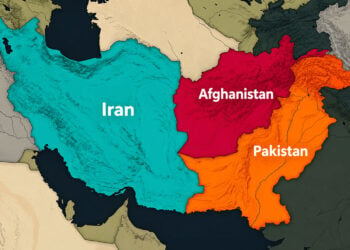
In the nearly three years since the Taliban’s rise to power, they have significantly expanded the unregulated and illegal extraction of the country’s mineral resources. The group has announced that during this period, they have signed contracts for the extraction of over 150 small mines with domestic companies and 30 large mines with Chinese, Iranian, Turkish, and Qatari companies. Meanwhile, the former Minister of Mines and Petroleum argues that Afghanistan lacks a legitimate government under international law, and no company or country has the right to enter into contracts with a geography devoid of a legitimate state. He asserts that any future government of Afghanistan has the right to take the contracting parties to international courts and seek compensation.
In May 2024, the Taliban-controlled Ministry of Mines and Petroleum announced that the group had secured investments exceeding $7 billion in Afghanistan from China, Qatar, Turkey, Iran, and the United Kingdom.
Homayoun Afghan, spokesperson for the Taliban-controlled Ministry of Mines and Petroleum, told the Taliban-controlled national radio and television (RTA) that, “In addition to domestic companies, companies from Qatar, Turkey, Iran, China, and the United Kingdom have invested in Afghanistan’s mining sector.” He added that these companies have primarily invested in the extraction of gold, copper, iron, cement, oil, and gas.
The Ministry of Mines and Petroleum announced that in the first two months of this Solar Hijri Calendar year (starting from March 20, 2024), they signed eight mining contracts with a total investment of over $40 million.
According to officials from this ministry, the signed contracts with domestic companies include two large mines and six small mines. The large mines include the Jegdalek ruby mine in Kabul and the barite mine in Herat, while the six small mines include two nephrite mines, two marble mines, one fluorite mine, and one lead and zinc mine.
In a recent development, the Taliban-controlled Ministry of Mines and Petroleum announced the sale of 20,000 tons of zinc extracted from the Yakawlang mines in Bamyan province to a domestic company for nearly $8 million.
Furthermore, this ministry under Taliban control has stated that 60,000 tons of crude oil from the Qashqari block were sold in a tender to a domestic company for over $30 million. This comes amid widespread criticism from the public and experts who argue that the Taliban’s mining operations are conducted secretly and at very low prices, lacking both domestic and international legitimacy. They question the duration of these mining contracts and how the revenues are being utilized. They stress that oversight of mining operations is only feasible through legal, professional, and specialized institutions.
Dawood Shah Saba, the former Minister of Mines and Petroleum in the previous government of Afghanistan, told the Hasht-e Subh Daily that Afghanistan lacks a national government from a political and international law perspective. He described the country as merely a geography under the control of a political-military group.
Mr. Saba emphasized that the minerals and underground resources belong to the people of Afghanistan and future generations, and no political-military group has the right to transfer or contract these resources to anyone. Therefore, no foreign group or company has the right to enter into contracts with a specific group in geography without a legitimate government, as only governments have the authority to grant mining contracts to individuals or legal entities.
The former Minister of Mines and Petroleum of Afghanistan emphasizes that any country or foreign company that signs mining contracts with a group in Afghanistan during the absence of a legitimate government does not have legal standing, and such contracts are invalid.
According to Mr. Saba, any future government in Afghanistan, established based on the will of its citizens, will have the right to take the countries and companies that entered into contracts with the Taliban to international courts and seek compensation. He clarifies that if the people of Afghanistan had an organized civil structure at present, they could have taken the contracting companies to international courts; however, Afghanistan is currently a borderless geography where those with the most power can do whatever they want.
The former Minister of Mines and Petroleum states that currently, the country’s mines and natural resources are being plundered at an unprecedented rate, leading to the destruction of underground resources and contributing to further social collapse and environmental destruction. The direct responsibility for this situation undoubtedly lies with the Taliban. Additionally, anyone else involved in this process that goes against national interests and the interests of future generations of Afghanistan shares this responsibility and will be accountable to the citizens of Afghanistan in the future.
Meanwhile, Foreign Policy magazine reports that the Taliban are providing 25% of the revenue from gold mining in the Badakhshan and Takhar provinces in northeastern Afghanistan to the al-Qaeda network. According to this report, since the beginning of gold mining in Badakhshan and Takhar in early 2022, al-Qaeda’s share of the revenue has reached $194.4 million. Foreign Policy has written that al-Qaeda has employed tens of thousands of workers for gold mining in Afghanistan, with Taliban fighters providing security for these workers.
Since the Taliban took control of Afghanistan, concerns have increased regarding the unregulated and illegal extraction of the country’s mines and underground resources. The Taliban have not provided detailed information about the contracts, and it is unclear based on which criteria these contracts are being made.
Comprehensive and complete information on Afghanistan’s underground resources has not been published. Estimates of the country’s mineral resources have always been approximate.
The previous government, through the publication of a “Mining Roadmap,” stated that fundamental studies to identify Afghanistan’s underground resources began in the mid-20th century. This document mentioned that when the Soviet Union came to Afghanistan, it collected a wide range of data and information regarding the country’s natural resources.
The studies conducted by the Soviet-supported government in Afghanistan included “systematic geographical mapping, collection and analysis of rocks and sedimentary layers, aerial geophysical surveys, and systematic mineral exploration.”
So far, no precise studies have been conducted on the number of mineral resources in the country. However, in the initial statistics published by the Taliban-controlled Ministry of Mines and Petroleum under the name “List of Mining Areas,” 680 mines have been reported.
It is also said that Afghanistan holds 2.2 billion tons of iron ore, about 60 million tons of copper, around 183 million tons of aluminum, approximately 2,700 kilograms of untouched gold, 1.3 billion tons of marble, over 500 million tons of limestone, and 1.4 million tons of rare earth elements such as lanthanum, cerium, and neodymium.
You can read the Persian version of this daily report here: