
Some sociologists in Kabul have expressed concern over the expansion of Taliban religious schools and their consequences for Afghanistan’s social structure. They say the increase in these schools, with the Taliban’s intended curriculum and educational approach, could, in the long run, affect the new generation’s attitudes toward society, culture, and social relations. According to them, the focus on religious education with a particular interpretation of Islamic concepts, along with the restriction of general and modern sciences, is paving the way for a decline in intellectual diversity in society.
In an interview with the Hasht-e Subh Daily, these sociologists warn that the continuation of this trend, in addition to limiting educational opportunities, could also increase the spread of extremism and the formation of radical viewpoints.
These concerns come as the number of religious schools in Afghanistan has increased in recent years, and the Taliban have also emphasized the expansion of these schools. Alongside the rise in the number of these schools, their educational content and their place within Afghanistan’s education system have become one of the focal points of experts’ concerns.
Rashed Sediqi, one of the sociologists, says that the existence of religious schools is not in itself problematic from a sociological perspective, but the type of curriculum, ideas, and ideology governing these schools can play an important role in shaping the social structure of society. He adds that some religious schools, instead of moving toward moderation and engagement with other sciences, have moved toward promoting radical and extremist views.
According to Sediqi, the introduction of extremist views into the curriculum of these schools could create a gap between graduates of religious schools and graduates of regular schools and academic centers, making social cohesion vulnerable.
Mr. Sediqi says: “The introduction of radical views into the curriculum of religious schools could create a gap between graduates of these schools and graduates of regular schools and academic centers. If the curriculum of these schools is not reviewed and brought in line with the needs of society, their expansion, instead of contributing to social welfare, could pave the way for increased extremism and further problems in Afghanistan.”
This sociologist warns that if the curriculum is not reviewed and the educational content is not aligned with today’s societal needs, the expansion of these schools could have further negative consequences for Afghanistan.
Zia Nikzad, another sociologist, says religious schools could become a tool for transmitting and institutionalizing the Taliban’s outlook among children and young people. He adds that the expansion of these schools, alongside existing restrictions, could further limit women’s presence in social, economic, and educational spheres and increase their dependence on men. According to Nikzad, the continuation of this trend could push Afghan society toward intellectual uniformity, the suppression of differing viewpoints, and increased social divisions.
Nikzad says: “If the trend of expanding religious schools continues, it could make society intensely religious and uniform, in such a way that differing viewpoints are suppressed. The continuation of this situation in the coming years could deepen social divisions and have dangerous consequences for Afghanistan.”
In the field of education, several activists say that the increase in religious schools, if general, scientific, technical, and vocational education is neglected, could disrupt the balance of Afghanistan’s education system. They warn that limiting opportunities to learn sciences and practical skills will also affect young people’s ability to enter the labor market in the future.
Azita Nazimi, an education activist, says the rise in the number of students at religious schools, without simultaneous attention to scientific, technological, and vocational education, could leave Afghanistan facing a shortage of skilled workers in the future. She emphasizes that religious education and general sciences should go hand in hand, and that alongside religious and moral education, students should also have the opportunity to learn mathematics, computer skills, and technical skills.
Nazimi says: “Religious education is not problematic in itself, but it becomes a problem when it takes the place of the technical, scientific, and skills-based education that society needs. If the number of students at religious schools increases while technological, vocational, and general education is neglected, the younger generation’s educational and job opportunities will be limited, and the country will face a shortage of skilled labor in the future.”
On the other hand, economic experts say that the expansion of religious schools, if not accompanied by the development of technical and vocational education, could also affect Afghanistan’s labor market in the coming years. According to them, the country’s economy needs skilled labor in various sectors to grow, and excessive focus on one type of education makes it difficult to meet the diverse needs of the labor market.
Qutbuddin Yaqoubi, an economic expert, says the expansion of religious schools could play a positive role if it is accompanied by proper planning and management. He adds that alongside religious education, investment in technical and vocational training and institutes could help offset part of the shortage of skilled labor in the country.
Yaqoubi says: “If religious schools are managed properly, they can be useful for teaching religious sciences, but if they proceed without planning and management, they will become a serious problem for Afghanistan. If more investment is made in technical and vocational education and institutes, part of the shortage of skilled labor in Afghanistan could be offset. From an economic perspective, the right approach is to strike a balance between religious education and technical education, because Afghanistan’s economy needs skilled labor in various sectors to grow and develop.”
Alongside these concerns, Richard Bennett, the United Nations (UN) Special Rapporteur on human rights, has warned in a report that the expansion of religious schools under Taliban rule could alter Afghanistan’s social structure and deepen the education crisis. He has also expressed concern about the educational content of these schools and emphasized the need to align education with the current needs of society.
The Taliban’s Ministry of Education has announced that the number of religious schools had reached more than 23,000 by September 2025. Zabihullah Mujahid, the Taliban spokesman, has also said that 10,363,000 students and religious students are currently engaged in learning at religious schools, regular schools, and universities.
The Taliban Supreme Leader had previously ordered the establishment of one large jihadi school in each province and up to 10 small religious schools in each district. Under this order, dormitories with a capacity of 500 to 1,000 religious students, a daily stipend of 150 afghanis per student, and at least 10 teachers have been allocated for these schools.
However, the Taliban have not provided a clear explanation regarding the exact content of the religious schools’ curriculum. Khalid Hanafi, the Taliban’s Minister for the Propagation of Virtue and Prevention of Vice, had previously described modern education as “permissible,” but had said that if it conflicted with the Taliban leader’s decree, “the emir’s ruling is obligatory.”
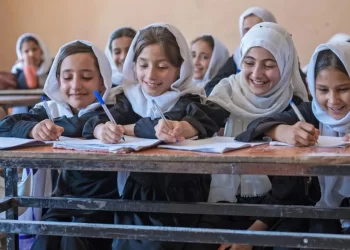
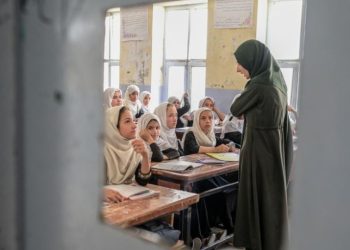
This trend continues as girls above sixth grade have been banned from attending school, and women and girls have been barred from studying at universities and higher education institutions, restrictions that, according to critics, alongside the expansion of religious schools, could further limit the educational balance and the educational and employment opportunities of the future generation.
You can read the Persian version of this report here:
گسترش مدارس دینی طالبان؛ نگرانی از تغییر ساختار اجتماعی و آینده آموزشی افغانستان