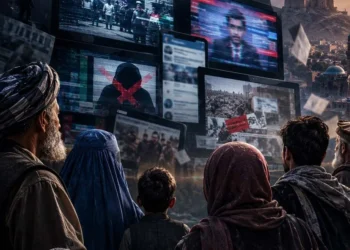
Recently, the Taliban’s Ministry of Information and Culture issued a new directive imposing further restrictions on the media. This directive consists of eight articles, all focusing on limiting media activities. One article states that political programs must first be recorded and then broadcast, meaning that “live broadcasts” are banned. Another article pertains to the invitation of political analysts to programs. According to its provisions, only those who support the Taliban and refrain from exposing their flaws should be invited as experts. Based on this, the Taliban have provided media outlets with a list of their preferred experts. Invitations outside this list are prohibited unless coordinated with the Taliban’s Media Oversight Committee. Additionally, media outlets are required to coordinate their daily program schedules and guest lists with this committee. Moreover, questioning the Taliban’s decisions has been prohibited. The media have been warned to remove any criticism directed at the Taliban or their officials before broadcasting recorded programs.
In this context, a few points deserve attention:
1) The imposition of restrictions on media activities by the Taliban is unsurprising, as the group has fundamentally opposed free media from the outset. When rumors of the Taliban’s return to power intensified, one major concern was the potential destruction of the achievements in media freedom. This concern has now been well justified. The Taliban’s opposition to freedom of expression is ideological. However, in certain areas, they adopt an ethnic stance, particularly in their refusal to establish an inclusive government. Essentially, media freedom belongs to the free and democratic world. No one should expect a group like the Taliban to respect it.
2) The Taliban suppress and censor media outlets that do not serve their interests. The group does not aim to eliminate all media, but rather to use the existing ones as instruments for their propaganda. This is a hallmark of totalitarian regimes. The Taliban allow media to operate as long as they promote the regime’s agenda. Similarly, they want political analysts to portray Afghanistan under Taliban rule as a paradise. The hiring and encouragement of YouTubers is another effort in this direction. The Taliban aims to sell the world on the idea that the praise for their regime in the media represents freedom of the press. The free world, however, pays little attention to the suppression of the press, largely because some media outlets are still operating in Afghanistan. This reveals that the nature of media activity is unimportant to the West. For example, democratic governments of the world sometimes declare the situation of women in Afghanistan unacceptable, not only because they are excluded from the regime, but because they lack access to education. If even a slight opening for women existed, they would likely abandon this cause.
3) The Taliban’s new expectations for media outlets under their regime come when these outlets have fully complied with the group’s preferences over the past three years. Had the media not done so, it is unclear what fate they would have met. Some well-known media outlets from the Republic era that are currently operating in Afghanistan have even sacrificed their reputation by portraying a favorable image of the Taliban. Yet, this group’s expectations have not lessened. For instance, if an incident happens in some corner of the world, these outlets report it; however, they refrain from covering even the simplest news of the daily mysterious and non-mysterious killings of dozens in Afghanistan. As a result, these media outlets do not reflect the people’s challenges but rather highlight the so-called achievements of the Taliban.
4) Many regimes around the world prioritize the suppression and censorship of free media, but none may compare to the Taliban regime in this regard. The Taliban’s recent restrictions are truly disgusting. The requirement for media outlets to obtain the Taliban’s permission before inviting an expert is one of the harshest tactics for suppressing media, a phenomenon unique to Taliban-controlled Afghanistan. Just as Afghanistan has become the only country in the world where women and girls are deprived of the right to education, it is now on the path to becoming the only country where a media outlet must obtain permission from the ruling Taliban regime to invite an expert. It can now be said that the achievements in the realm of freedom of expression over the past twenty years have been destroyed.
In these circumstances, if it weren’t for exiled media outlets, how would the people of Afghanistan become aware of the painful and wounded state of their country?
You can read the Persian version of this analysis here: