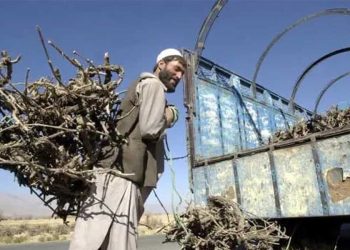
Several residents of Nuristan province have expressed serious concern over the increasing unchecked deforestation in the province. According to them, forest coverage has declined significantly in recent years. They emphasize that profiteers and timber smugglers cut down trees and transport the wood outside the country. These residents say that the widespread use of wood in various aspects of daily life, especially in the Kolm area, has further reduced forest cover. They add that the lack of effective management and, at times, public negligence also lead to forest fires. Meanwhile, several environmental experts have warned about the continuation of this trend, stressing that despite the vital role of forests in combating climate change, around half of the country’s forests have been destroyed.
Mehdi (pseudonym), a resident of Nuristan, says that because the Taliban only have access to the provincial center of Parun, timber smugglers freely cut forest trees in other areas. According to him, most high-quality timber is smuggled from Barg-e Matal and Kamdesh districts into Pakistan.
This Nuristan resident adds that due to the lack of effective management by the Taliban and the negligence of local people, forest fires occasionally occur in Nuristan. He says, “One of the other challenges in Nuristan is that the Taliban only have access to the center of Parun. People in other districts cut trees illegally. Timber smuggling has continued in Nuristan since the time of the republic, and under the Taliban, most high-quality wood is smuggled from Barg-e Matal and Kamdesh districts to Pakistan. At times, Nuristan’s forests also catch fire due to the absence of Taliban management and the carelessness of residents, such that the forests of Nurgram district and the Surich area in Doab district have witnessed devastating fires in the past.”
Faizullah (pseudonym), another resident of Nuristan, also expressed concern over widespread deforestation in the province. According to him, forests have declined sharply in recent years. He adds that in some areas of Nuristan, trees are cut secretly.
This resident says, “When I speak about the forests of our province, the reality is that the situation is worrying. Forests that for years were the source of greenery and beauty in this region have significantly diminished in recent years. Despite the restrictions and bans announced, trees are still secretly cut in some areas.” According to him, most forests are destroyed by profiteers and timber smugglers who cut trees at night or in remote areas and transfer them outside Afghanistan. In addition, poverty and the needs of some residents have driven people to cut trees for fuel or income.
Faizullah adds: “Although the Taliban have made efforts to prevent deforestation and monitoring has increased in some areas, full control has still not been achieved due to the mountainous terrain and the vast extent of the forests. As a resident of Nuristan, we ask the Taliban to provide alternative livelihoods for people to prevent deforestation. Raising public awareness about the importance of preserving forests can also play an important role in addressing this issue.”
Zainab (pseudonym), another resident of Nuristan province, says that the use of wood in all aspects of life in the Kolm area has led to a significant reduction in trees there. According to her, despite the formation of a local council and a ban on cutting green and fruit-bearing trees, the trend continues.
Zainab says, “Recently, with the increase in population in Nuristan, deforestation has risen significantly. In the Kolm area, people use wood as fuel in all aspects of their lives, including cooking and heating their homes, which has greatly reduced the number of trees in this area. Local elders last year formed a community council and banned the cutting of fresh and fruit-bearing trees, including pine nut trees, but despite this, due to the lack of sufficient facilities to transport wood to areas farther from Kolm, people in this area still cut fresh and fruit-bearing trees.”
At the same time, Sayed Mohammad Salman Khel, an environmental expert, warned about the continuation of deforestation and said that despite the important role of forests on the front line of combating climate change, about 50 percent of the country’s forests have been destroyed.
Mr. Salman Khel says: “Forests in the world are recognized as the first line of defense in the fight against climate change. Decades of insecurity have created conditions for illegal logging. In the past, we had about three to four percent forest cover, but now 50 percent of it has been lost. Deforestation harms not only humans but also the environment. It causes soil erosion, destroys wildlife habitats, and disrupts the process of oxygen production. As a result, hundreds of benefits provided by forests are lost.”
Referring to recent floods and droughts, this environmental expert adds that deforestation must be prevented to avoid a humanitarian disaster. He says: “To protect forests, the Taliban and national and international institutions have an important role. Afghanistan, which has been severely affected by climate change, has faced consecutive droughts in recent years, and floods have also increased. Groundwater levels have declined, and fertile lands are moving toward desertification. To combat climate change, reforestation must be prioritized to prevent a humanitarian disaster caused by these changes and to minimize the damage.”
These concerns are raised as the Taliban recently set fire to forests on a mountain in Tanbana village of Dara district in Panjshir province solely due to security concerns and to “open their field of vision.”
Previously, a large-scale forest fire had also occurred in the Damkot area of Nurgram district in western Nuristan.
You can read the Persian version of this report here:
تبر قاچاقچیان بر گلوی جنگلات نورستان؛ فاجعهای که کسی جلو آن را نمیگیرد