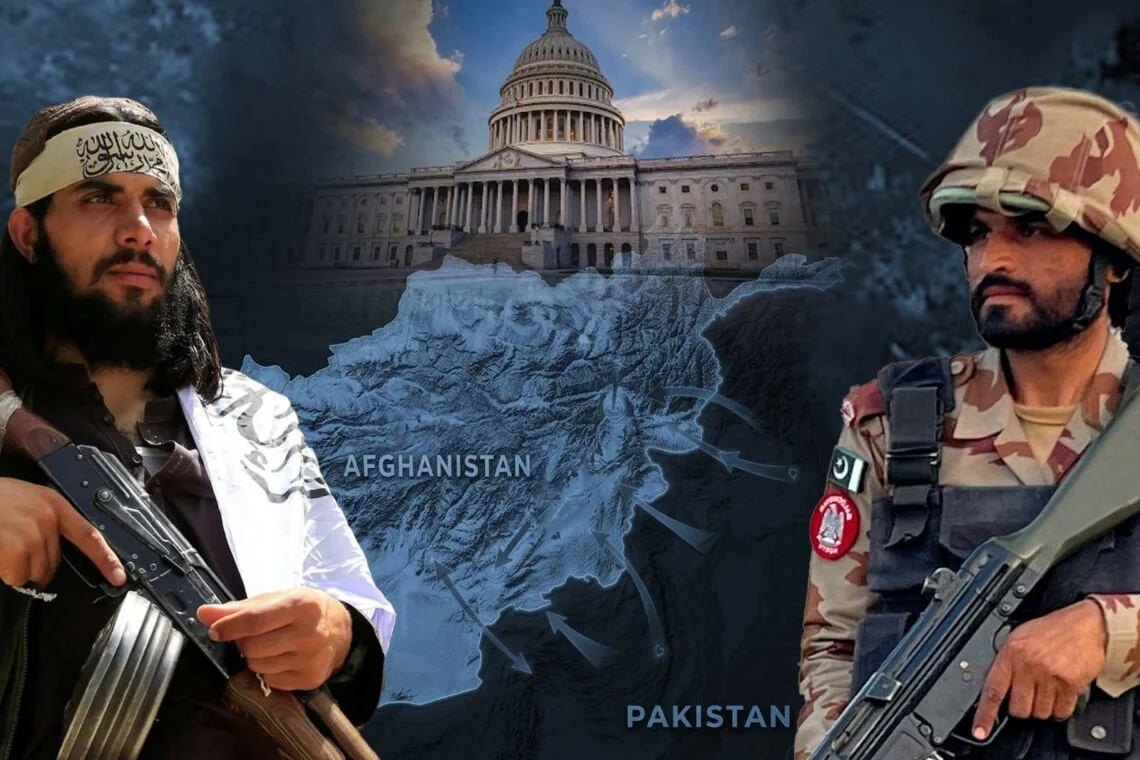
Marco Rubio, the Secretary of State of the United States, said recently at the Group of Twenty (G20) foreign ministers’ meeting in Atlanta, Georgia, in response to a reporter’s question about the war between the Taliban and Pakistan and Russia’s mediation between the two, that if an opportunity for mediation exists, Washington will also step in. At the same time, he welcomed Pakistan’s position in fighting what it calls terrorism. Pakistan and the Taliban have both reacted to Rubio’s remarks. Both welcomed American mediation, though the Taliban showed more enthusiasm than Pakistan.
When we look at the eagerness of some countries, particularly major powers, to mediate between Pakistan and the Taliban, we find that the group’s regime considers prolonging and escalating tensions with Islamabad to be in its interest. The more the existing tension escalates, the more the Taliban’s name is on people’s lips, and the group is spoken of as the ruling regime in control of Afghanistan, supposedly at war with an aggressive foreign country in defense of Afghanistan’s interests. Likewise, as mediation efforts intensify, the more important countries in the region and beyond roll up their sleeves to resolve the problem. China, Russia, Saudi Arabia, Qatar, Türkiye, Iran, and now the United States have either actually undertaken mediation, which has not produced any particular result, or expressed willingness to do so.
When this many regional and extra-regional powers enter the scene, it benefits the Taliban regime. At the very least, Taliban representatives travel continuously to other countries and sit at the negotiating table on an equal footing with the other side (Pakistan). They meet with high-ranking officials of other countries as the ruling authorities of Afghanistan and speak about how to ensure regional security and curb terrorism originating from Afghanistan. At least in appearance, they try to stand in a position of defending Afghanistan’s interests. This means that even if Afghanistan under Taliban administration is not at the center of the international community’s attention, at least a few powerful countries come looking for it and make efforts to resolve its problems with its neighbors.
Given what has been said, if the United States enters the field of mediation, it would be full of advantages for the Taliban. Mediation means that the mediating force is, in principle, “neutral,” listens carefully to the views of the parties to the conflict, and seriously pursues paths and openings that could lead to “the resolution of hostility.” Likewise, while observing the principle of neutrality, it persuades the parties to the conflict to make concessions in some areas and to remain faithful to the principle of “give-and-take” in negotiations. When the United States, the world’s foremost power, wants Pakistan, a nuclear power and an official member of the international community, to grant concessions to the Taliban regime, which still lacks national and international legitimacy, this is not a trivial or insignificant event. The importance of this point becomes clearer if we consider the United States a backer of Pakistan, particularly in confronting the Taliban regime. That being the case, the United States would in principle focus not on mediation but on exerting pressure on the Taliban. When it does not do so, the ground is paved for granting concessions to the Taliban.
Moreover, the Taliban burn with longing for friendship with the United States. The group’s regime is looking for a pretext to become friends with the United States. Talks with Pakistan, especially under American mediation, are the best pretext for getting closer to Washington. In that case, the Taliban can both boast that they have drawn the world’s foremost power into the arena and raise the level of engagement with the White House. If that happens, we will witness a new round of engagement between the United States and the Taliban. Of course, in this potential process, the Taliban will try to convey their own narrative of insecurity in Pakistan and the activities of Tehrik-e-Taliban Pakistan (TTP) to the United States, an impression that may well influence the White House’s perception.
On the other hand, the United States is not uninterested in establishing a relationship with the Taliban, though one that would not grant legitimacy to the group’s regime. As for ending the conflict between Pakistan and the Taliban, it is not only willing but also very eager. Donald Trump himself has commented on this repeatedly and has revealed his interest in mediating, though without entering the arena. If the conflict between the Taliban and Pakistan escalates and the United States enters the scene as a mediator, it would not be surprising for a man like Trump to host representatives of the parties in Washington and, by signing a memorandum of understanding between them, claim that he has ended yet another war and is now more deserving than ever of the Nobel Peace Prize. If the United States is genuinely seeking a minimal, not necessarily maximal, relationship with the Taliban, the mediation affair is a good justification and answers some of the possible criticisms.
More importantly, there is even a possibility that in the coming weeks and months the Taliban will raise the level of tension with Pakistan so that the United States is compelled to mediate. The reason, as stated above, is clear: to benefit from meetings with American representatives in the mediation process. For now, Rubio’s remarks amount to a media question-and-answer exchange, not necessarily an official US position. Rubio did not say that the United States will definitely mediate, but made it conditional on a favorable environment. Another sensitivity should not be overlooked: if the United States steps into the scene, China, Russia, and Iran will be displeased. This is a triangle that has tried to end the tension between the Taliban and Pakistan but has failed.
You can read the Persian version of this analysis here: