While the Taliban take the threat of ISIS very seriously in practice, their propaganda suggests that this group has no physical presence in Afghanistan and should not be a cause for concern. Recently, Sirajuddin Haqqani, the Taliban’s Minister of Interior, and Abdul Haq Wasiq, the group’s Director-General of Intelligence, have claimed that destructive groups, including ISIS, do not exist in Afghanistan, and that the media is spreading politically motivated and targeted propaganda about the activities of groups opposed to the Taliban regime. This is not the first time the Taliban have openly lied, even ignoring the daily actions of their fighters against ISIS, the National Resistance Front of Afghanistan, and the Afghanistan Freedom Front (AFF), which are also reported by the Taliban’s media outlets. Lying is a fundamental element of any reactionary, hierarchical, closed, and ideological system. In such systems, significant investment is made in falsehoods, and much of what is displayed is not reality but a lie disguised as truth, promoted in such a way that it is accepted as genuine reality. This effort can only be successful if a skillful disinformation strategy, supported by significant media power, is employed.
Currently, the Taliban are not powerful enough to dominate the media field in competition with so-called free media. Although they have left no stone unturned in controlling domestic media, turning them into propaganda arms of the regime for a long time, a large portion of the media field is not under Taliban control. Despite all their efforts, they have not been able to fully control foreign media. Fortunately, in the era of communications and social networks, no force can fully occupy the media field. For this reason, senior Taliban officials occasionally warn of the undeniable and uncontrollable power of free media in the propaganda war against them, revealing their weakness in this area. When the Taliban cannot defend their reactionary narrative against the immense power of the media, they resort to short-term and temporary solutions. Filtering news websites and arresting and punishing anti-Taliban media personnel are examples of such actions, which lack long-term and sustainable impact. Thus, the Taliban’s lie that ISIS is not present in Afghanistan cannot even convince their members, let alone opponents who do not easily accept Taliban propaganda.
If the Taliban know that ISIS is present in Afghanistan and understand well that they cannot eliminate free media in their propaganda, why do they try so hard to ignore the reality of ISIS or pretend to downplay it? Ideological groups, no matter how much they lose the propaganda field to their enemies, do not submit to reality and continue their stubbornness. Therefore, the more challenging the opposing groups become, the more the Taliban will ignore them. This is a propaganda principle that all political movements and regimes more or less apply. ISIS is a serious weakness for the Taliban, just as the Taliban was a weakness for the Western-supported government in Afghanistan. In practice, the Taliban see ISIS and are deeply afraid of this group, but they confidently propagate as if there is nothing to worry about.
The previous government also spread disinformation in such a way that everyone believed the Taliban were “breathing their last breaths”; but in the end, we saw what happened in reality. The Taliban’s fight against ISIS is much more challenging than the previous government’s fight against the Taliban. Because ISIS and the Taliban are ideologically and even in appearance so similar that they are almost indistinguishable, suppose you live under Taliban control in Afghanistan. In that case, you will certainly notice that during routine inspections in cities and highways, the fighters of this group, who travel with ordinary people, are more questioned than other passengers. If they do not have identification cards, they get into trouble. According to the United Nations Security Council, ISIS has managed to infiltrate the Taliban deeply. This is something the Taliban never want to acknowledge, and they are desperately trying to cleanse their ranks of ISIS, which they will not be very successful at.
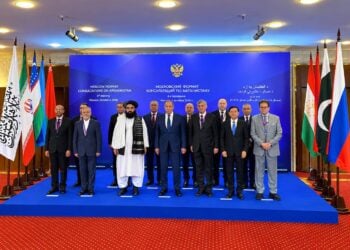
On the other hand, emphasizing the absence of ISIS in Afghanistan and claiming nationwide security by the Taliban’s Minister of Interior and Director-General of Intelligence can also be seen as a propaganda play to attract the attention of regional countries and other governments involved in the Afghan crisis. They want to show that they have achieved significant success in the fight against ISIS and can be counted on as a key partner in the “fight against terrorism.” If you look at the approach of Russia and the US in dealing with the Taliban – both trying to outdo each other in engaging with this group – there is no doubt that the Taliban have played the game well so far. It is no secret that ISIS is a serious threat both to Afghanistan and the Taliban; but ISIS is also a tool for political profiteering, serving to extend the Taliban project. The leaders of this group have learned well how to ensure their survival by strengthening the industry of terror: while portraying themselves as victims of the “fight against terrorism” and seeking global cooperation, they strive to be recognized as the only force capable of fighting terrorist groups. The Pakistani army, as one of the main players in the terror industry, has been successfully playing this familiar game for years. It seems the Taliban are also taking cues from their old masters here.
You can read the Persian version of this analysis here: