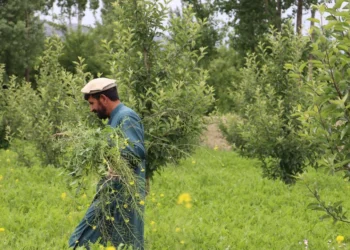
Several Afghan dried fruit exporters have reported that pistachios have been harvested prematurely over the past two years, before reaching the “shool” (a term used in parts of Afghanistan for the period when pistachios are mature and ready for harvest) stage. They note that this early harvesting has significantly impacted the quality of pistachios and their export process, undermining the product’s reputation in global markets. They also emphasize that the presence of nomads in pistachio forests has caused severe damage to these natural resources, as nomads use pistachio trees for fuel and livestock feed.
Exporters are calling on the Taliban to implement clear regulations and practical measures to prevent the harvesting of unripe pistachios and the destruction of forests, thereby creating conditions to preserve and enhance the export of this valuable product.
Some exporters, in interviews with the Hasht-e Subh Daily, stated that the presence of nomads in pistachio forests has caused significant damage to these natural resources. According to them, nomads cut down pistachio trees to obtain fuel and feed for their livestock. These traders warn that if nomads are not removed from these areas, the forests could be destroyed soon.
Ghulam Yahya Meshkwani, a dried fruit exporter from Afghanistan, expressed concern about the premature harvesting of pistachios. He noted that in the past, pistachio harvesting began on September 11, but now this process takes place two months earlier. According to him, this has led to a decline in quality and a drop in the price of pistachios.
Meshkwani added: “Thirty to thirty-five years ago, when we were young, pistachio harvesting began on September 11according to a specific order. At that time, one kilogram of pistachios yielded about 400 to 500 grams of kernels. The pistachios were white, high-quality, and suitable for export. But now, unripe pistachios are harvested, yielding only 100 to 150 grams of kernels. This represents a 75 percent reduction in yield, which is a significant loss.”
This dried fruit exporter identified the presence of nomads in the region as another challenge, stating that they have caused damage to these natural resources by settling in pistachio forests and cutting down trees for fuel. He added: “For thirty years, nomads have settled in this area, built houses, and cut down trees for fuel. Their sheep also feed on these trees. Even in winter, they use a type of heater called a ‘chilla,’ and each household burns over 100 kilograms of firewood from these trees nightly during the three months of winter.”
The trader warned that if nomads are not removed from the pistachio forests, there is a risk that these forests could be entirely lost shortly. He noted that Afghanistan’s high-quality pistachios, known as “Pista Khandaan,” have been replaced by imported pistachios from Iran, and local pistachios are no longer available in the domestic market.
Ahmad Shah Yarzada, another dried fruit exporter from Afghanistan, said that over the past two years, pistachios have been harvested before fully ripening, expressing dissatisfaction with this trend. According to him, if pistachios are harvested at the appropriate time, all export shipments could secure a strong position in international markets.
Yarzada added, “Pistachios are a national asset. In previous years, the quality of Afghanistan’s pistachios was excellent, and pistachio kernels were sold for up to 33 or 34 dollars per kilogram. However, due to neglect and declining quality, the same pistachios are now sold for 22 dollars. Some prematurely harvested pistachios are of such low quality that we are forced to sell them for only 10 dollars.”
This pistachio exporter emphasized that in the past, people were expelled from pistachio forests one to two months before the official harvest season began. However, now everyone has built homes within the forests and grazes their livestock there, making the situation extremely difficult to control. He warned: “As long as these people remain in the heart of the pistachio forests, the people of Afghanistan will not benefit from pistachios. This season alone, pistachios have the potential to generate 50 million dollars in revenue. If these forests are protected for another 20 days and harvested on time, this income could reach 100 million dollars. We are a poor and needy country; it is a pity to lose 50 million dollars when God has given us this blessing for free.”
Some economic experts say that from an economic perspective, any product harvested prematurely loses its quality. They note that poverty and unemployment are the main drivers of early harvesting of products in Afghanistan.
Abdul Nasir Rishtia, an economic affairs expert, said on the matter: “In general, when a low-quality product enters the market, its price decreases, and it loses the ability to compete with foreign products. Poverty and unemployment have driven people to harvest products, especially pistachios, before they are fully ripe to earn a small income to sustain their daily lives.”
He believes that raising awareness about the importance of timely harvesting, providing technical and economic assistance to farmers, establishing processing centers, and building cold storage facilities could encourage people to harvest pistachios at the right time.
Previously, the Taliban governor’s office in Badghis Province announced in a statement that a special committee had been established to prevent the early harvesting of pistachios, but no practical steps have been taken in this regard.
The natural pistachio forests in the provinces of Badghis and Herat, known as “Pista Laiq,” are a significant source of income and natural resources for the residents of these areas. The pistachios grown in these forests are not only popular domestically but also have a large market internationally due to their high quality.
The United Nations Food and Agriculture Organization (FAO) has reported that between 2021 and 2023, over 1.5 million pistachio saplings were planted in Badghis province to restore pistachio forests.
The UN agency added in a report: “Afghanistan once had more than 450,000 hectares of pistachio forests, but war, poverty, overexploitation of trees, unsustainable harvesting, and excessive livestock grazing have caused widespread destruction of these forests.”
You can read the Persian version of this report here:
پسته افغانستان؛ از صادرات جهانی تا نابودی در آتش فقر و بینظمی