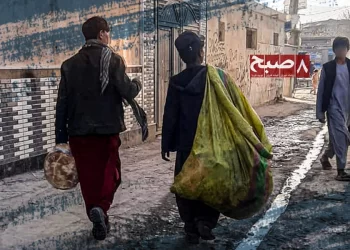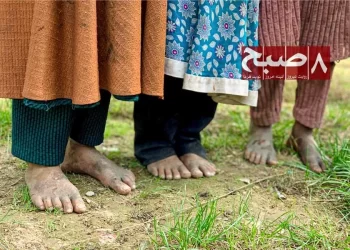

After the Taliban takeover, Afghanistan is facing more poverty, hunger, and unemployment than ever before. The depth of poverty can be seen in the eyes of child laborers who grapple with a multitude of problems. Thousands of children in Badakhshan province lack shelter, security, and well-being, confronting arduous tasks.
Child laborers in Badakhshan province lament the absence of shelter, legal protection, and sustainability. According to them, poverty and family hardships force them to spend their days on the streets and in mines, engaged in strenuous labor.
Ahmadullah, an 11-year-old, works in a gold mine in the village of Shahi Khurd, in the eighth district of Fayzabad, the capital of Badakhshan province. The mining, one of the most exhausting and laborious jobs, has cast a shadow of darkness and despair over this child’s life.
Facing the hardships and numerous challenges of life, this child complains about his father, who went to Iran to support the family after the republic fell but tragically lost his life in a construction accident there.
Ahmadullah, now the breadwinner of their family of six, along with his 17-year-old brother, has been forced to drop out of school. He says, “I was in the sixth grade when I left school, and it’s been three years since I’ve been working in this mine. Mining is tough, and I carry packs of mine materials with a string in tunnels up to 50 meters long.”
Deprivation and uncertain fate are not the challenges that only Ahmadullah and his brother face; poverty and unemployment have led many families in Badakhshan to send their children to laborious work to make ends meet. Instead of education and experiencing childhood, these children are grappling with the harsh realities of life and labor from an early age, bearing the weight of responsibilities far beyond their years.
Another child laborer in Badakhshan is Ebadurrahman. He describes himself as the sole breadwinner of his family, forced to shoulder the heavy burden of providing for their needs.
He says, “Our circumstances were dire, and I left school after the sixth grade. But due to the financial constraints of my family, I couldn’t pursue education and dream of becoming a doctor in the future.”
The increase in child laborers in Badakhshan following the Taliban’s takeover has raised serious concerns among residents and child rights activists in the province. They paint a grim picture of the future for child laborers in Badakhshan and call on the Taliban regime to create educational opportunities and support programs for children.
Sayyar Malikzada, a children’s rights activist and a resident of Badakhshan province, speaking to the Hasht-e Subh Daily, expresses concern over the increasing number of child laborers, blaming local Taliban authorities in the province for their inability to manage the situation.
Malikzada states, “Officials in Badakhshan cannot manage the crisis facing children, and with each passing day, the number of child laborers increases. This situation could lead to a major challenge in the long run.”
He adds that the uncertain fate of child laborers and the absence of a structured education plan will have serious repercussions on society, especially on child laborers in Badakhshan.
However, the Taliban-controlled Department of Labor and Social Affairs in Badakhshan attributes the economic problems of the people and the increase in child laborers to the legacy of the previous government. Nonetheless, they claim efforts are underway to gather child laborers and provide educational opportunities for them.
Khair Mohammad Safdar, the head of the Labor and Social Affairs Directorate for Badakhshan province under the Taliban, states that they are coordinating with various internal and external entities to create educational opportunities for these children.
Meanwhile, some officials in the Labor and Social Affairs Directorate in Badakhshan, under Taliban control, report an 80% increase in child laborers in the province over the past year.
Abdul Saboor Foladi, the Director General of the Social Procurement Department for the Taliban’s Directorate of Labor and Social Affairs in Badakhshan, states that their Directorate’s assessments indicate that more than eight thousand children are currently engaged in laborious work in mines and on roads in Fayzabad, the capital of this province.
According to official statistics from this Directorate, last year there were 8,450 child laborers in Badakhshan, but due to poverty and unemployment, this number is increasing.
He mentions that most of these children, due to their families’ poverty and destitution, work tirelessly on roadsides and in mines, located approximately fifty kilometers from Fayzabad, enduring harsh weather conditions such as snow and rain, deprived of education and the opportunity to attend school.
He adds that around 300 of these children have been provided with educational opportunities by an aid organization.
Although child labor has been prevalent in Afghanistan for years, with many children forced to work to support their families, residents of Badakhshan province claim that the number of child laborers has increased significantly following the Taliban’s rise to power. According to them, the Taliban are responsible for the disappearance of opportunities and the increase in unemployment in the country.