• 8AM.MEDIA
  • ویب‌سایت فارسی
  • پښتو ویب‌پاڼه
  • اۉزبېکچه ویب‌سایت
  • Podcast
Sunday, October 4, 2026
Hasht-e Subh
  • Home
  • News
    • Afghanistan News
    • World News
  • Opinion
    • Editorial
    • Analysis
  • Reports
    • Daily Reports
    • Investigative Reports
  • Society
    • The story of people
  • Women’s Word
  • Columns
    • Three Years After Afghanistan’s Fall: The Taliban’s Resurgence
    • Towards Equality
    • The Resurgence of the Taliban: Two Years Since Afghanistan’s Fall
    • Hebatullah Report Special Edition
    • Resistance for Education Special Edition
    • Special Column on Taliban’s Education Curriculum
    • Nawroz
  • Interviews
  • Contact Us
    • About Us
    • 8AM MEDIA Annual Awards
    • Submit an Article to Hasht-e-Subh
  • 8am.mediaBack
Subscribe
No Result
View All Result
  • Home
  • News
    • Afghanistan News
    • World News
  • Opinion
    • Editorial
    • Analysis
  • Reports
    • Daily Reports
    • Investigative Reports
  • Society
    • The story of people
  • Women’s Word
  • Columns
    • Three Years After Afghanistan’s Fall: The Taliban’s Resurgence
    • Towards Equality
    • The Resurgence of the Taliban: Two Years Since Afghanistan’s Fall
    • Hebatullah Report Special Edition
    • Resistance for Education Special Edition
    • Special Column on Taliban’s Education Curriculum
    • Nawroz
  • Interviews
  • Contact Us
    • About Us
    • 8AM MEDIA Annual Awards
    • Submit an Article to Hasht-e-Subh
  • 8am.mediaBack
No Result
View All Result
Hasht-e Subh
No Result
View All Result

Environmental Destruction Under Taliban Rule

Muhammad Ali Nazari Muhammad Ali Nazari
11 July 2024 - Solar Hijri Date: 1403/04/21 [t_time:1720696248]
Environmental Destruction Under Taliban Rule

According to the United Nations report, Afghanistan is one of the six countries most vulnerable to climate change. One of the major factors contributing to climate change is the excessive emission of greenhouse gases, primarily by industrialized nations. Afghanistan, lacking significant industrial visibility, contributes negligibly to the production and emission of greenhouse gases. Reports indicate that our country accounts for a mere 0.8% of greenhouse gas emissions globally, yet it suffers severely from the impacts of these emissions. For this reason, the United Nations annually receives funds from countries with higher contributions to greenhouse gas production and allocates them to countries most affected by climate change, helping them adapt and increase their resilience to these environmental changes—a budget from which Afghanistan is currently deprived.

Since the collapse of the government of Afghanistan and the absence of a functioning legal authority, UN assistance in climate change mitigation has been suspended. Meanwhile, the ruling group itself is implicated in environmental degradation and has not declared any specific plans to combat environmental destruction and climate change.

Droughts that persist, shifts in rainfall patterns, devastating and awe-inspiring floods, rapid glacier melting, increased particulate matter, and more are among Afghanistan’s most tangible consequences of climate change. These events have imposed significant human and financial losses on the Afghan people, adversely affecting household livelihoods.

The environmental protection administration established in Afghanistan is now managed by the Taliban. Like all government bodies, Taliban leadership has appointed several clerics as heads and officials who have no familiarity with environmental issues and do not prioritize environmental conservation. Placing non-professionals at the helm of a professional environmental protection agency is not only hostile toward the institution itself but ultimately represents overt hostility toward the environment.

A regime and government that values the environment and climate change would not politically confront these phenomena and would appoint knowledgeable and professional individuals to relevant positions.

While the environmental protection administration did not receive much attention during previous governments, it has lost its importance under the Taliban regime. Due to the Taliban’s failure to disclose their annual government budget, it is unclear how much budget has been allocated to this agency. It can be speculated that the entire budget allocated to this critical agency is not even equivalent to one-fourth of the Ministry of Promotion of Virtue and Prevention of Vice’s budget. Disregarding the environmental protection administration is in itself a manifestation of hostility towards both the environment and its safeguarding institutions.

In addition to these issues, the Taliban also exhibit other blatant hostilities towards the environment. One of these is the widespread deforestation and trafficking of timber to Pakistan from eastern provinces. Despite ostensibly establishing military units to prevent timber smuggling to Pakistan, the destructive deforestation process has not halted, nor has the timber trafficking route been closed. Therefore, the Taliban’s negligence in preventing deforestation amounts to a form of hostility towards the environment. Since seizing power, there have been several significant forest fires in the country, for which the Taliban have been accused of negligence and indifference in firefighting efforts. Speculations exist regarding the intentional nature of these fires to facilitate deforestation.

Reckless and unprofessional mining extraction practices and dumping of waste in open environments are further examples of environmental destruction by the Taliban. The unchecked extraction and non-professional transport of coal specifically harm the environment and ultimately jeopardize the health of the country’s citizens. Since taking power, the Taliban have unprecedentedly increased mining activities, including coal extraction, with China and Pakistan, as major buyers, purchasing these minerals from the group at minimal costs. To fund their regime’s expenses and enrich their leadership, the Taliban have focused extensively on increasing mining activities, leading to internal conflicts among various Taliban factions over control and the division of mining revenues. The reckless mining extraction by the Taliban across the country is essentially pillaging, and destroying the environment.

Under Taliban rule, the control over environmental destruction and climate change impacts, where the latter exacerbates the former, remains unaddressed. The current regime not only downplays these issues but also lacks representation in important international climate change forums. Instead, they contribute to environmental degradation. With the Taliban’s interference or neglect, forest fires are ignited and the process of deforestation continues. Droughts have worsened desertification trends. Qatari sheiks and other business partners of the Taliban freely travel to Afghanistan and engage in hunting endangered and rare bird species.

In Taliban governance, if floods occur, warnings are not adequately issued, and if they are, affected populations receive minimal aid after the fact. During flood events, Taliban machinery and manpower are not dispatched to assist the affected people. In such circumstances, concerns about further environmental destruction under the shadow of a group that accepts no responsibility and is unaccountable to anyone have increased. These concerns are valid and justified.

In Taliban rule, the length and breadth of citizens’s trousers are more important than ensuring human survival and the future of humanity.

You can read the Persian version of this analysis here:
تخریب محیط زیست با حاکمیت طالبانی | روزنامه ۸صبح 

ShareTweetSendSendShare

Related Posts

Heavy machinery processes gravel at a gold mining site in Badakhshan province, where farmland is increasingly sold or seized for mineral extraction. (Photo credit: 8am.media)
Daily Reports

Plundered Amid Poverty: Badakhshan’s Farmland Vanishes for the Price of Gold

11 July 2026 [t_time:1783787824]
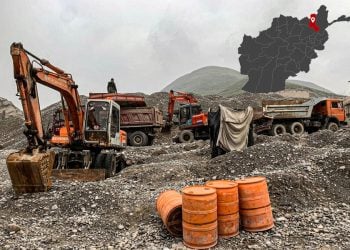
Excavators and trucks dig through gravel at a gold mining site in Takhar province, with a map marking the region. (Photo credit: social media)
Daily Reports

Uncontrolled Extraction of Mines in Takhar; Ai-Khanum and Khatayan on the Verge of Destruction

6 July 2026 [t_time:1783345572]
Motorcycles, cars, and a public transport vehicle navigate heavy nighttime traffic congestion on a Kabul street, reflecting the city's growing urban transport crisis. (Photo credit: 8am.media)
Daily Reports

Kabul Residents Decry Worsening Public Transport Shortage and Traffic Crisis

16 May 2026 [t_time:1778936251]

Latest

Loading latest news...

Popular stories

  • Surveillance footage shows Taliban fighters surrounding and shooting a bound man in Herat. (Photo credit: Social Media)

    Taliban Shoot Young Man from Herat After Torturing Him with Hands Tied

    Share
    Share Tweet
  • UN Report Reveals Shifts in Family Attitudes and Rise in Domestic Violence in Afghanistan

    Share
    Share Tweet
  • Al-Qaeda Releases Hamza bin Laden Message on 9/11 Anniversary

    Share
    Share Tweet
  • Afghanistan Journalists Center: Taliban Have Detained Around 300 Journalists and Media Workers

    Share
    Share Tweet
  • Freedom Front Claims 37 Taliban Fighters Killed in Nuristan and Kunar

    Share
    Share Tweet

Podcast

Insights
Insights

Join Lynne O’Donnell for 8AM’s podcast series, Insights.
Lynne talks with generals, diplomats, soldiers, journalists, politicians, activists, people who have front row seats for conflicts around the world, and citizens with a story to tell, happy or sad. For this first series, Afghanistan is the focus. Lynne and her guests talk about the collapse of the republic in August, 2021, and the impact since — for the people of Afghanistan, for the security of the region, for the safety of the world. It’s important, interesting and insightful.

Insights/22: Controlling the Narrative with Mina Sharif
byinsights8am

Controlling the Narrative

Lynne O’Donnell talks with Mina Sharif, author, activist, women’s rights campaigner, educator and mentor. They discuss who controls the narrative and who speaks for Afghanistan’s people when the Taliban appear to have seized control not only of the country but of the message, too.

Have a listen

Insights/22: Controlling the Narrative with Mina Sharif
Episode play icon
Insights/22: Controlling the Narrative with Mina Sharif
Episode Description
Episode play icon
Insights/21: Media Meltdown with Zahra Joya
Episode Description
Episode play icon
Insights/20: Terror Inc with Scott Richards
Episode Description
Episode play icon
Insights/19: Busting Stereotypes with Bushra Gohar
Episode Description
Episode play icon
Insights/18: Media Matters with Waliullah Rahmani
Episode Description
Episode play icon
Insights/17: What Goes Around Comes Around with Sima Samar
Episode Description
Search Results placeholder
Hasht-e Subh

8AM Media, also known as Hasht-e-Subh Daily, stands as Afghanistan's premier independent and non-profit newspaper, resonating as a beacon of journalistic integrity since its establishment in June 2007 by esteemed Afghan journalists and human rights advocates. With a steadfast commitment to citizen journalism and civic education, Hasht-e-Subh Daily has earned its place as the most esteemed publication in the nation.

Publisher: Sanjar Sohail
Email: [email protected]
Executive Director: Parwiz Kawa
Email: [email protected]

Read More

Mineral Water: Safeguarding Health or Making Kabul Families Sick?

Trump Announces ‘Superintelligence Task Force’ to Boost US AI Leadership

Muttaqi Travels to Russia for Eighth Moscow Format Meeting

Taliban Announce Completion of First Transit Road Linking Badakhshan and China

Mecca Agreement vs. the Taliban, India and Israel: Is a New Regional Alignment Taking Shape?

Editor’s Choice

Every Saturday morning, 8AM MEDIA English Services Department will guide you through the week’s biggest stories from Afghanistan and the international community.

Subscribe

© 2026 - ©Hasht-e Subh Daily

No Result
View All Result
8am.Media
پښتو ویب‌پاڼه
ویب‌سایت فارسی
اۉزبېکچه ویب‌سایت
  • Home
  • News
    • Afghanistan News
    • World News
  • Opinion
    • Editorial
    • Analysis
  • Reports
    • Daily Reports
    • Investigative Reports
  • Society
    • The story of people
  • Women’s Word
  • Columns
    • Three Years After Afghanistan’s Fall: The Taliban’s Resurgence
    • Towards Equality
    • The Resurgence of the Taliban: Two Years Since Afghanistan’s Fall
    • Hebatullah Report Special Edition
    • Resistance for Education Special Edition
    • Special Column on Taliban’s Education Curriculum
    • Nawroz
  • Interviews
  • Contact Us
    • About Us
    • 8AM MEDIA Annual Awards
    • Submit an Article to Hasht-e-Subh
  • 8am.media

© 2026 - ©Hasht-e Subh Daily