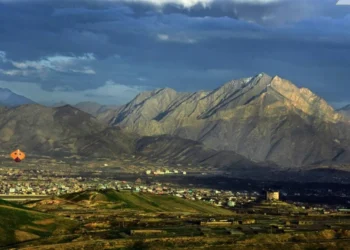
This piece traces how Juma Fateh joined the Taliban. It examines the path through which Juma, son of “Talban,” who once brought joy and excitement to local gatherings in the remote valleys of Nusay district in Badakhshan as a musician playing the tabla, transformed into one of the Taliban’s most bloodstained commanders. He went on to rise to the position of deputy governor and now controls extensive financial and economic resources.
Juma Fateh, commonly known as “Juma-e Talban,” is a resident of Shaakhdara village in Nusay district. He was born into a poor rural family and spent his childhood and adolescence in difficult economic conditions and hardship. Juma completed his primary and secondary education at Zaghar High School, finishing the eleventh and twelfth grades at Nusay High School, while working alongside his father on the farm. His former classmates describe him as a sociable, adventurous young man who was occasionally prone to trouble. According to them, Juma rarely stayed within the usual bounds of rural life.
During his teenage years, Juma Fateh worked as a shopkeeper in the market at the center of Nusay district. Residents give differing accounts of that period. Some describe him as a hardworking young man, while others recall him as a controversial and adventurous figure. However, on one point, there is little disagreement among the accounts: his strong passion for music and singing.
Juma Fateh sang at local gatherings and sometimes performed alongside Zaker, a local singer from Radooj village, at community events. In those days, few imagined that his life would one day lead him into insurgent activity or that he would become one of the Taliban’s prominent figures in the Darwaz districts. He had also taken part in village council elections and was elected for one term as head of the village council of Shaakhdara.
After finishing school, Juma Fateh joined the HALO Trust demining organization and worked there between 2009 and 2013.
Theft, Murder, and Joining the Taliban
After his time at the demining organization, Juma Fateh planned and attacked the organization’s director. He attempted to kill the director of the demining organization in the Jamarch area of Nusay but did not succeed. He then fled the area and took refuge in a village called Khoi.
Some time later, Juma Fateh, along with a number of his associates, stole part of the teachers’ salaries in Obghan village. After that, in 2014, as Taliban activity increased in Badakhshan, he left his village together with Dadakhuda Mutawakkil, the Taliban’s current commander in Nusay, and several other residents of Shaakhdara, moving to more remote and mountainous areas.
At that time, his name began to surface in security and political circles in the Darwaz districts. He joined the Taliban together with a man named Islamuddin from his own village in Raghistan district and went to Wardooj district for military training. After Islamuddin was killed while making homemade landmines, Juma Fateh succeeded him in the Darwaz districts. According to local sources, several prominent Taliban commanders from Badakhshan, including Mawlawi Qahar, a Taliban military division commander during the 2010s and the current deputy for logistics at the Taliban’s Ministry of Interior, who is said to be a relative of Juma Fateh, played a role in his rise as a Taliban official in the Darwaz districts.
Based on accounts from local sources, Juma Fateh gradually transformed from an obscure figure into an influential one among local Taliban fighters. His emergence within the Taliban remains a puzzling question for residents of Nusay, many of whom ask how someone who once played the tabla and sang at celebratory gatherings ended up joining the Taliban and becoming a prominent figure within the group.
Between 2016 and 2018, Juma Fateh was arrested three times along with five of his men by the police of the former government in this district. However, according to local sources, he was released each time through the mediation of residents. It is said that he had also established ties at the time with several individuals in the then National Directorate of Security of Afghanistan, some of whom played a role in securing his release.
In 2020, Juma Fateh took part in several attacks on Nusay and Maimay districts. The attacks he planned and carried out resulted in the deaths of a large number of residents and local forces. In Maimay district alone, in November 2020, more than 27 young men were killed with the cooperation of terrorist groups from Tajikistan, and the district fell under the group’s control for two days.
Juma Fateh has survived several airstrikes. In one of these attacks, he was severely wounded. According to local sources, the injury left one of his hands paralyzed and damaged one of his eyes.
Juma’s story reflects part of the complex realities of the years of war in Afghanistan. A review of this Taliban figure’s life shows how poverty, insecurity, and weak state institutions can push young people’s lives down unexpected paths.
Juma Fateh Today
Although Juma Fateh has now officially been introduced within the Taliban’s formal structure as deputy governor in Zabul province, his real influence remains tied to Badakhshan, particularly Nusay district and the Darwaz region. Recent reports indicate that he still holds sway over part of the local armed networks in Nusay, and his name has once again come to prominence amid renewed tensions over gold mines. Local sources say that forces and individuals affiliated with him have played a role in recent disputes over gold extraction, a development that prompted senior Taliban military officials to travel to Nusay to contain the tensions.
In his most recent reported remarks, Juma Fateh has claimed that in the Nusay district of Badakhshan alone, he commands 2,500 armed “mujahideen”/fighters equipped with light and heavy weapons. It has also been reported that he gathered around 150 armed Taliban fighters, along with hundreds of Taliban members and residents, at the Al-Fattah madrassa and called on them to protest against the order issued by the Taliban governor of Badakhshan to halt gold extraction. These statements and activities suggest that, despite his official transfer to Zabul, Juma Fateh still considers himself an influential player in the power dynamics, resources, and local armed networks of Badakhshan.
You can read the Persian version of this report here: