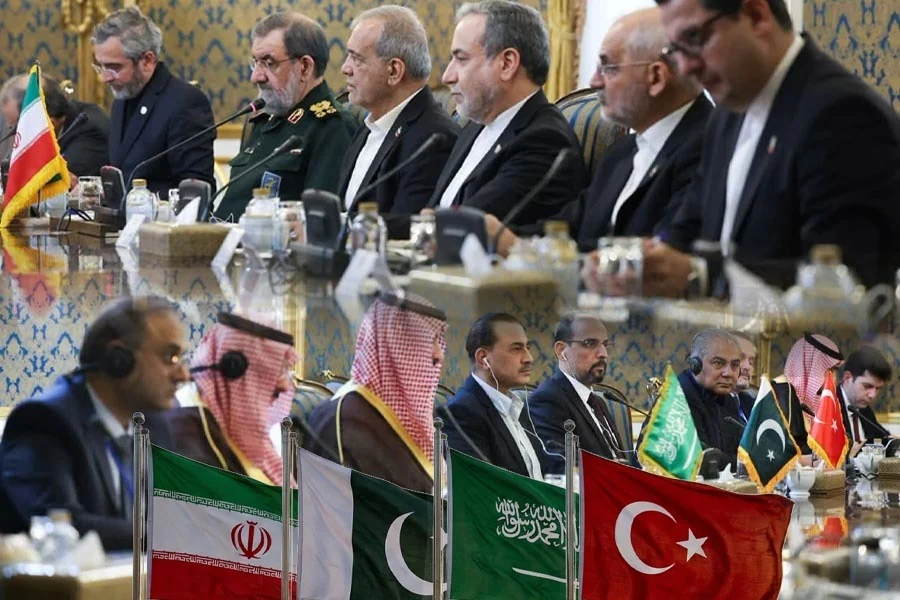
The visit to Tehran by senior officials from the member states of the “Mecca Pact” (Khalid bin Salman, Saudi Arabia’s Minister of Defense; Asim Munir, Chief of Army Staff of Pakistan; and Ibrahim Kalin, head of Türkiye’s National Intelligence Organization, MIT) and their meetings with high-ranking officials of the Islamic Republic is a significant development. It matters because another war between Iran, the United States, and Israel is a conceivable prospect. It matters because the newly founded Mecca Pact is widely regarded as “anti-Iranian.” It matters because all three guests are top-tier military and security officials of the pact. And finally, it matters because Saudi Arabia, the pact’s most pivotal member, is engaged in a war with Yemen’s Houthis, a regional ally of the Islamic Republic.
Several points are worth noting regarding the content and objectives of this visit and the meetings that took place:
1) The prevailing perception is that the Mecca Pact is anti-Iranian and was established essentially to contain the Islamic Republic and its regional allies. Saudi Arabia’s central role in the pact, the fact that all three member states are Sunni, and their leaning toward the West have fueled this speculation. The suspicion grows even stronger when the tense history between Riyadh and Tehran is taken into account. Had Saudi Arabia not been at the center of the Mecca Pact, and had the situation in the Middle East not been so volatile, the suspicion that the pact is anti-Iranian would not have become so prominent. On this basis, it is highly likely that the recent meetings conveyed this message to Tehran: that the Mecca Pact is not fundamentally anti-Iranian and that the Islamic Republic should not fear it. Apparently, Tehran’s own understanding of the Mecca Pact, contrary to the prevailing perception, is also that it is not anti-Iranian.
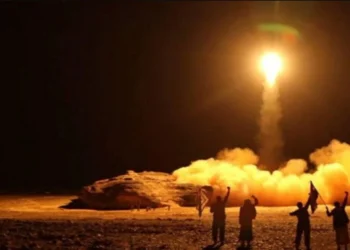
2) The Houthi file was also very likely on the agenda of the four-sided meetings. For the time being, Saudi Arabia is engaged in a war with the Houthis, and the prospect of an end to this conflict is not clear. The Houthis are an ally of the Islamic Republic, and in Riyadh’s view, they are supported by Iran and also obey it. Until now, the “defense clause” of the Mecca Pact has been focused mostly on the Houthis, but it has not proven as effective as expected. Given this, Tehran has probably been asked that, if it does not restrain the Houthis, it should at least stop supporting them, a claim the Islamic Republic has rejected many times. Of course, making a request aimed at restraining the Houthis is very hard to swallow for the Mecca triangle, particularly Saudi Arabia, because it signals weakness when a coalition with such a name and standing cannot prevail on the battlefield in a war against a paramilitary group.
3) Mediation between Iran and the United States was also very likely a focus of the parties’ attention. The United States not only has full confidence in the Mecca Pact, but its members are also considered Washington’s allies. On the other hand, Iran counts on Türkiye and Pakistan, even though it is suspicious of Riyadh. If mediation is to take place, no force stronger than the Mecca triangle can be found. If the Mecca triangle is determined to mediate, the file of the Iran-United States war is one of the difficult tests facing it. If the Mecca triangle carries out this grave and difficult mission properly, it will gain a considerable advantage, and by relying on it, it can present itself as a “peace-seeking” force and play an effective role in shaping the new (post-war) situation in the Middle East. Furthermore, when the issue of mediation is at stake, it is hard to imagine that this visit took place without the consent and prior coordination of the United States.
4) It is unclear whether the Mecca Pact’s three-way intercession will prevent another war from breaking out. If it does not, the triangle will be preparing for a more dangerous possibility: an Iranian attack on United States military bases in the countries along the southern edge of the Persian Gulf, especially Saudi Arabia. On this basis, it would not be surprising if Iran were asked not to attack Riyadh’s interests in the Middle East. In the event of war, the Iranian side would not accept such a request unless its own demands were taken into account. The Islamic Republic will argue that the United States’ refraining from attacking Iran is conditional on the Islamic Republic’s refraining from attacking Riyadh’s interests in the region, and otherwise there will be no room for patience and restraint. In any case, the Mecca triangle has no choice but to dissuade Iran from attacking Saudi Arabia’s interests, whether through threats or inducements.
Just as confronting the Houthis is a difficult test for the Mecca triangle (one in which its success has so far been limited, if not absent), confronting an Iran at war with the United States is also a test, and an even harder one than that of the Houthis. If a war breaks out, the Islamic Republic attacks Saudi Arabia’s interests, and the defense clause of the Mecca Pact fails to deliver any meaningful deterrent effect, it would not be surprising if the pact gradually lost its usefulness, leaving nothing of it but the name and title it currently holds.
You can read the Persian version of this analysis article here: