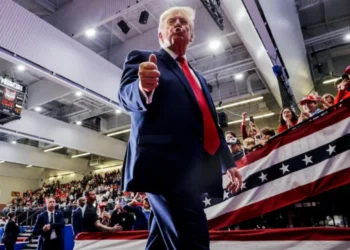
Donald Trump, the President of the United States, in his first speech at the U.S. Congress before hundreds of Republican and Democratic representatives and senators, expressed gratitude to Pakistan for its cooperation in the arrest of Mohammad Sharifullah, who is identified as the main perpetrator of the suicide attack at Kabul Airport. Shehbaz Sharif, the Prime Minister of Pakistan, was also taken by surprise and expressed his gratitude and delight at Trump’s remarks. Tammy Bruce, the spokesperson for the U.S. State Department, praised Pakistan’s role in Sharifullah’s arrest and described Islamabad as a crucial partner for Washington in the fight against terrorism. Michael Waltz, the U.S. National Security Advisor, also commended Islamabad’s role in a conversation with Muhammad Ishaq Dar, Pakistan’s Foreign Minister, on behalf of Trump and called for continued joint efforts in combating terrorism. Ishaq Dar, while expressing his satisfaction, requested the retrieval of American weapons from the Afghan Taliban—something that may not be entirely out of reach.
Since the Taliban came to power in Afghanistan, Pakistan has faced numerous challenges, including a surge in attacks by Tehrik-i-Taliban Pakistan (TTP), economic instability, Baloch separatism, sectarian conflicts, India’s growing presence in international relations, New Delhi’s increasing proximity to the Kabul regime, and strained ties between Islamabad and the ruling government in Kabul. In this fragile and precarious situation, Trump’s recent stance and his praise of Pakistan serve as a morale boost for the country’s civilian and military leadership, breathing new life into its governance. Therefore, it is not far-fetched to assume that Pakistan’s move to arrest Sharifullah was not coincidental but rather a calculated action that might have been orchestrated months or even years in advance to win Trump’s favor and seize an opportunity to navigate its current crises.
Trump’s praise of Pakistan’s counterterrorism efforts becomes more significant when considering that Pakistan itself has long been accused of supporting terrorist groups—an accusation acknowledged even by its allies. More importantly, Trump was previously one of Pakistan’s harshest critics, repeatedly accusing it of deception and terrorism sponsorship, claiming that it had siphoned billions of U.S. dollars under the pretext of fighting terrorism while actually fostering extremism and radicalism. Because of this, he had suspended nearly $4 billion in military aid to Pakistan—even at a time when U.S. troops were still in Afghanistan and Washington was reliant on Islamabad’s cooperation, particularly as peace talks between the U.S. and the Taliban were underway in Doha. During his first administration, Trump favored New Delhi, often praising its role in the global economy and modern technology—a stance that was particularly irksome to Pakistan. Now, as Trump speaks positively about Islamabad, it signals a serious diplomatic maneuver by Pakistan—especially at a time when the new occupant of the White House indiscriminately criticizes both allies and adversaries, and few nations have received his commendation.
The dust from Trump’s remarks had not yet settled when Pakistan presented a significant request to the U.S.: the retrieval of military equipment from the Taliban. Ishaq Dar, in his conversation with Waltz, emphasized the need for the U.S. to reclaim its military gear. Similarly, Khawaja Muhammad Asif, Pakistan’s Defense Minister, underscored this demand. Over the past three years, no country has criticized the Taliban’s possession of American weapons as strongly as Pakistan has. While Islamabad is considered a U.S. ally, it would be expected that countries like Iran, China, or Russia—rather than Pakistan—would be more concerned about this issue, yet they appear relatively indifferent. According to Pakistan’s claims, TTP fighters have been armed with advanced weapons left behind by U.S. forces in Afghanistan—an assertion that seems credible, given that every time Pakistani soldiers have been targeted, the attacks have been notably precise, indicating the use of modern military equipment in these operations.
Now, the situation for the Taliban has become more challenging. If Pakistan’s lobbying efforts persist and gain traction, Trump may become even more determined to retrieve the military equipment from the Taliban, which would undoubtedly be detrimental to the current regime in Kabul. It is even possible that, in return for Pakistan’s service, Trump could decide to transfer the retrieved military equipment to Pakistan. If this scenario becomes increasingly likely, the Taliban will have no choice but to turn their backs on TTP to maintain Pakistan’s favor—an option that would come at a high cost for them. If they refuse, they risk not only clashing with Pakistan but also facing repeated warnings from Trump. However, another kind of deal is also conceivable: allowing the Taliban to retain the military equipment in exchange for severing ties with TTP. Of course, this depends on whether the newfound camaraderie between Trump and Pakistan proves to be short-lived.
The Taliban’s reaction is also noteworthy: accusing Pakistan of supporting ISIS. This response reflects the Taliban’s anxiety—possibly because they had previously claimed to have killed the perpetrator of the attack and may have received concessions from the previous U.S. administration. Ideally, the Taliban should have welcomed the arrest of the attacker and emphasized the importance of joint counterterrorism efforts. Given that nearly 200 Afghan citizens were killed in the attack, the Taliban should have expressed satisfaction over the capture of the mastermind if they genuinely cared about the protection of Afghan civilians. However, instead of showing approval, Taliban spokespersons reacted with complete discontent toward Trump’s speech, accusing Pakistan of supporting ISIS—an allegation that the White House is unlikely to heed, especially at a time when its primary focus remains on the seemingly positive image of Pakistani officials.
You can read the Persian version of this article here: