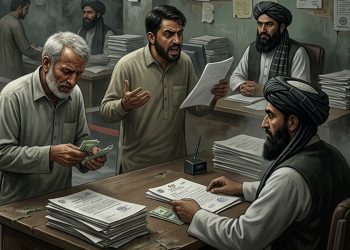

Several citizens of Afghanistan have complained about negligence and disorder in offices under Taliban control. They say that improper, arbitrary, and unprofessional conduct are among the serious problems in these offices. According to them, in many cases, visitors who are not proficient in Pashto are not treated properly by Taliban staff. These citizens further add that their affairs are left pending for days and even weeks without any clear reason, and due to errors made by employees, they are forced to visit the offices multiple times to correct their documents, incurring additional costs. Meanwhile, girls have also expressed concern about the slow pace of work and inappropriate behavior in these offices, saying that when they visit, they face even greater challenges and restrictions.
Tayeb (pseudonym), a resident of Kabul, strongly criticizes the sluggishness and disorder in offices under Taliban control. He says these offices resemble “cronyism bureaus” more than formal, professional institutions. According to him, improper, arbitrary, and unprofessional conduct are among the serious problems in these offices.
Tayeb adds: “If you visit offices under Taliban control to get something done, you will clearly see how visitors are treated in an inappropriate and unprofessional manner. One of the main reasons for this situation is the appointment of illiterate, semi-literate, and unqualified individuals by this group. Assignments to government positions are made more based on personal preference and affiliation than on merit and competence. If a visitor is not proficient in Pashto, employees do not treat them properly, and in many cases, due to the lack of a common language, even basic communication between employees and visitors does not happen properly.”
This Kabul resident says, “One day I visited the Taliban’s Supreme Court. One of the employees, who appeared to be very young, was sitting arrogantly in his chair, and, for a while, he did not even pay attention to visitors. When I raised my issue, he only responded with a nod of his head. I did not know whether to stay or leave. He was not proficient in Dari either, while most of the visitors were Dari-speaking.
In addition to these problems, instances of disrespect and inappropriate treatment of women are also observed. Offices under Taliban control have more of an ethnic, arbitrary, and regional character, and fall far short of the standards of a national and public institution.”
Yaser (pseudonym) also complains about the inappropriate conduct and slow pace of work in offices under Taliban control. He says that with the Taliban’s return to power in Afghanistan and the handing of key decision-making positions to individuals affiliated with the group, visitors to government offices have encountered an unprecedented level of negligence.
This Kabul resident adds: “In the past, during the republican system, despite all its shortcomings, the presence of skilled and specialized individuals had made the workflow in offices considerably more organized and faster. At that time, the affairs of visitors were usually handled accurately and without errors, and people’s time was wasted less. But now this situation has changed significantly. Most of those currently serving in positions of department heads, directors, managers, and at a higher level, in ministerial posts, lack knowledge, skills, and expertise, and the vast majority of them have only completed a six-month course in Islamic jurisprudence and Hadith.”
Mr. Yaser then refers to an action taken by the Taliban’s Ministry of Higher Education, saying that the holding of symbolic exams and the awarding of bachelor’s and master’s degrees to tens of thousands of madrassa students has paved the way for more unqualified individuals to fill positions in government offices, something that he says has intensified negligence and inefficiency.
This Kabul resident says: “The Taliban’s Ministry of Higher Education, by holding a symbolic exam in previous years, awarded bachelor’s and master’s degrees to tens of thousands of students from their madrassas. This measure has further enabled incompetent and minimally literate individuals to occupy more positions in government offices, and has caused negligence and inefficiency to grow day by day. The affairs of visitors in offices are left pending for days and weeks without any clear reason. In many cases, the appointed individuals are incapable of carrying out tasks properly, and even spelling and writing errors occur during the processing of documents. Sometimes visitors are left confused and are forced to return multiple times to correct their documents and pay additional costs, costs that are effectively imposed on the people.”
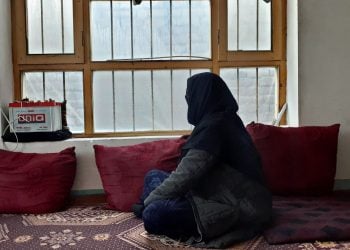
Zahra (pseudonym), a girl who was interrogated by Taliban members when she visited the city’s Education Directorate for not having a male guardian, says that as a girl, she frequently encounters indifference, long delays, and a lack of accountability when visiting offices under Taliban control. According to her, tasks that under normal circumstances should be completed within a few hours or a single day sometimes take days and even weeks. She emphasizes that for girls, these problems are compounded because the existing restrictions on women’s education, work, and social presence have made every visit to a government office an experience filled with stress and anxiety.
Ms. Zahra says, “When we visit Taliban offices, they first ask where our male guardian is. If a guardian is not with us, they do not allow us to enter. On the other hand, because we are girls, our affairs are passed from one department to another and deliberately delayed. As a girl, when I visit an office under Taliban management to get something done, I am often met with indifference, long delays, and a lack of accountability. Tasks that might normally be completed within a few hours or a day sometimes take days and even weeks. This negligence not only wastes people’s time and energy but also destroys their trust in the administrative system. The way employees behave also makes one feel afraid.”
Khalil Ahmad Nadeem attributes the slow pace of work in offices under Taliban control to a lack of trust within the administrative structure, the assignment of tasks to unqualified individuals, and the sidelining of experienced personnel.
Mr. Nadeem says, “There are many problems in offices under Taliban control. In the past, processing a property deed typically took between one week and ten days, but now this process can take up to a year. There is a lack of trust among Taliban members themselves.
Previously, official letters were delivered directly by individuals, but now Taliban offices send them through the postal system, which takes considerably more time. Tasks have not been assigned to those qualified to carry them out, and many of the individuals appointed by the Taliban lack the necessary skills. Tasks that should be completed simultaneously are sent and received multiple times between offices due to errors, which causes a great waste of time. Furthermore, the Taliban have either retired experienced individuals or removed them from their positions.”
This is while the Taliban, following their return to power in Afghanistan, have dismissed a large portion of former government employees and replaced them with individuals affiliated with them.
These sweeping changes to the administrative structure have not only reduced the capacity and expertise within government institutions but have also seriously disrupted the delivery of services to citizens. A shortage of qualified personnel, insufficient experience among Taliban-appointed employees, and the dominance of personal connections over meritocracy have been cited as factors that have led to increased disorder and delays in the handling of administrative affairs.
You can read the Persian version of this report here:
کمکاری و بینظمی در ادارات زیر کنترل طالبان؛ مردم به ستوه آمدهاند