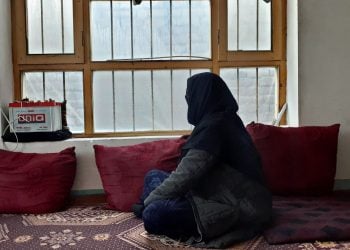
According to the Taliban’s newly published “Propagation of Virtue and the Prevention of Vice” law, women’s voices are considered “Awrah” (Intimate parts) and can only be heard in cases of necessity. They are permitted to leave home only with their faces covered, and they must refrain from raising their voices. The law prohibits hearing women’s voices and music from homes, and drivers are forbidden from transporting women without a male guardian. Additionally, all games and forms of entertainment, including marble and walnut games, are banned as haram (forbidden). Western-style haircuts are deemed an imitation of non-Muslims and infidels, and men are required to grow their beards without trimming them shorter than a fist-length. The law also bans the wearing of neckties, which it describes as a symbol of the cross. Furthermore, merchants, tradespeople, and farmers are not only obligated to pay taxes but also zakat (charity) and tithe. The use of statues of living beings in advertisements is prohibited, and the group’s morality police, known as “Muhtaseeb,” are authorized to imprison individuals for periods ranging from one hour to three days. The law grants the Muhtaseeb authority to interfere in the most private aspects of citizens’ lives, including inspecting their phones and computers for photos and videos of living beings.
Hibatullah Akhundzada, the Taliban’s hidden supreme leader, recently ratified the Ministry for the Propagation of Virtue and the Prevention of Vice law, consisting of one preamble, four chapters, and 35 articles. This law was enacted based on his decree No. 9, dated October 24, 2022. Akhundzada’s orders mandate that these regulations apply to all institutions, public places, and individuals living in Afghanistan, with no exceptions. Foreigners residing in Afghanistan are also required to adhere to the Taliban’s decrees.
Article 3 of this law defines Taliban-specific terms, including “Muhtaseeb,” which refers to someone granted authority by Hibatullah Akhundzada. According to his order, the Muhtaseeb (Morality Police) are empowered to impose discretionary punishments and discipline citizens of Afghanistan.
Women’s Voices Deemed “Awrah” and the Imposition of Taliban’s Veil Mandate
The Taliban’s law defines their version of “sharia-compliant hijab.” According to clause 10 of article 3, “sharia-compliant hijab” refers to clothing that covers a woman’s entire body and face, and is not thin, short, or tight. Article 13 of this law makes it mandatory for women to cover their entire bodies. It describes hearing women’s voices through loudspeakers, in chants, or recitations as “awrah.” As per the Taliban’s order, women are required to completely cover their bodies and faces. The article states: “Women must cover their entire bodies. It is necessary to hide the face due to the fear of temptation. A woman’s voice (singing, chanting, or reciting aloud) is considered awrah (Intimate parts). Women’s clothing must not be thin, short, or tight. Muslim women are obligated to hide their bodies and face from non-mahram (unrelated) men.”
Clause 6 of Article 13 states that covering a woman’s face and body is “obligatory.” It also emphasizes that Muslim women should cover themselves in the presence of non-Muslim and immoral women due to the “fear of temptation.” Clause 7 further adds that unrelated men and women should not gaze at one another, as the Taliban consider such acts to be “haram.” According to the Taliban’s interpretation, “It is haram for unrelated men to look at the bodies or faces of unrelated women, and it is haram for unrelated women to look at unrelated men.”
Although the Taliban have restricted women’s movement over the past three years, the new law stipulates that any violation of these rules will result in punishment. Based on this law, young women leaving their homes must cover their faces and bodies, and their voices must not be heard outside. According to clause 8 of article 13, “Whenever a grown woman leaves her house out of necessity, she is obliged to cover her voice, face, and body.”
Muhtaseeb’s Intrusion into Women’s Private Lives
The Taliban’s Muhtaseebs (Morality Police) are given the responsibility to investigate and monitor even the most private aspects of citizens’ lives. According to article 22, “The Muhtaseeb is responsible for preventing adultery, whether forced or consensual, whether hidden or public.” However, the law does not clarify how the Muhtaseebs can gain access to private extramarital affairs. This opens the door to further abuses, allowing the Taliban to engage in extortion and entrap individuals.
Despite the Taliban’s claims that they respect the religious freedoms of other sects, the law includes a provision banning temporary marriages (Sigha). Clause 1 of Article 22 states: “Temporary marriage (Sigha) is not permissible.”
The law also prohibits anal intercourse, even between husband and wife, although it does not explain how the Muhtaseebs would monitor or intervene in such matters.
Article 22 of this law states: ‘Engaging in illicit relationships with multiple women, lesbianism, sodomy (even with one’s wife), and child abuse are prohibited.’ This comes despite the numerous video recordings circulating on social media showing senior members of this group engaging in ‘child abuse’ and ‘sodomy.’
Last year, a video emerged showing Mullah Ahmad Akhund, a senior Taliban-appointed official in Kabul’s electricity company known as Da Afghanistan Breshna Sherkat (DABS), engaging in sexual relations. He was a powerful and influential Taliban figure with a history of similar relations with younger members of the group.
Restrictions Imposed on Men and Muhtaseeb’s Interference
The Taliban’s law not only imposes numerous restrictions on women but also places significant obligations on men, depriving them of sports and entertainment. The law strips men of the right to choose their clothing and appearance, while also enforcing strict limitations on their religious practices.
Article 14 of the Taliban’s law instructs men not to wear short or tight clothing that reveals the “protrusions” of their bodies. According to this article, “A man’s ‘awrah’ extends from his navel to his knees, including the knees.”
The law obliges men to wear clothing during sports and recreational activities that is not tight-fitting and do not reveal the shapes of their bodies. Clause 3 of the article reads: “Men are required to wear clothing that conceals their ‘awrah’ during sports and recreation. The clothing must not be tight, and the shapes of their bodies should not be revealed.”
The Taliban also instruct men not to shave their beards, specifying that if they trim it, it should not be shorter than a “fist-length.” Haircuts “contrary to Islamic principles” are also forbidden, although the law does not clarify what constitutes a Sharia-compliant haircut.
Clause 20 of Article 22 emphasizes that “resemblance in appearance and conduct to non-Muslims” is impermissible, and the Muhtaseebs are tasked with preventing such behavior. The law also bans the use and promotion of neckties and other symbols deemed “un-Islamic” by the Taliban.
Duties of Taliban’s Muhtaseeb
Article 16 of the Taliban’s law mandates the Muhtaseeb to compel all government employees and ordinary citizens to “revere” Islamic symbols. According to this article, if someone disobeys these orders, the Muhtaseeb must administer punishment. Clauses 1 and 2 state: “A Muhtaseeb is responsible for compelling government employees and the public to venerate Islamic symbols. A Muhtaseeb is tasked with punishing offenders and administering corrective discipline.”
Muhtaseeb’s Interference in Media Affairs
This law authorizes a Muhtaseeb to interfere in all aspects of citizens’ individual and collective lives. Muhtaseebs have the right to regulate and censor both state and private media outlets. They are required to prevent the publication of images of living beings and any content deemed un-Islamic by the Taliban.
Article 17, under the title “Duties of a Muhtaseeb Regarding the Media and Information,” states: “A Muhtaseeb is responsible for ensuring that media and information officials comply with Islamic virtues when publishing. Content that contradicts Sharia or disrespects Muslims is prohibited. Publishing images of living beings is forbidden.”
The Muhtaseeb’s Grip on Merchants and Farmers
The new law has empowered the Taliban’s Muhtaseebs to enforce strict regulations on merchants and farmers. According to Article 18, all traders, shopkeepers, and farmers are obligated to participate in congregational prayers and pay “Zakat, tithe, and other financial obligations to the rightful recipients,” namely the Taliban. Failure to comply with these requirements subjects individuals to punitive measures imposed by the Muhtaseebs.
Article 18 stipulates: “The Muhtaseeb is responsible for ensuring that merchants, shopkeepers, and farmers adhere to specific obligations, such as participating in congregational prayers at the mosque at designated times, timely payment of Zakat, tithe, and other financial obligations to rightful recipients, conducting business per Hanafi jurisprudence, and refraining from engaging in usury, hoarding, deceit, undercutting, and weight manipulation.” Furthermore, this article bans shopkeepers from selling statues of living beings. It emphasizes that the use of statues for commercial advertisements is prohibited, and no one is allowed to sell human body parts such as hair, kidneys, or eyes. Previously, the Taliban had already mandated that shopkeepers decapitate mannequins or cover their heads and faces.
Muhtaseebs Shadow Citizens During Leisure Activities
The Taliban’s Propagation of Virtue and Prevention of Vice law targets the most private aspects of individual and communal life. Under this law, officials responsible for recreational and tourist spots must build mosques and ensure that people attending these places participate in congregational prayers. Those who fail to do so face discipline from the Muhtaseebs.
According to Article 19, “The Muhtaseeb is responsible for obliging those in charge of recreational and tourist areas to build mosques for congregational prayers and ensuring that visitors attend congregational prayers in the mosque.”
Muhtaseebs’ Control Over Drivers
The law extends the Taliban’s supervision and mandates over drivers and passengers, down to the hour and minute. Anyone who travels must schedule their trips around prayer times.
Article 20 states that drivers are forbidden from transporting women who, according to the Taliban, do not observe proper hijab, and they are also prohibited from playing music. Furthermore, they must plan their trips so that passengers can perform their prayers at the designated times. This article adds, “The Muhtaseeb is responsible for obliging vehicle owners and drivers to refrain from playing music, prevent the use and trafficking of drugs, avoid transporting improperly veiled women, prevent the mingling of unrelated men and women, and disallow the transport of women without a sane, adult male guardian. Transportation companies must arrange their vehicles so that drivers and passengers can perform their prayers on time.”
Muhtaseebs Extend Control to Bathhouses and Swimming Pools
Article 21 gives the Muhtaseebs authority to strictly monitor public bathhouses and swimming pools to ensure that people observe “Awrah” in these places. The article states, “The Muhtaseeb is responsible for ensuring that people conceal their awrah in public bathhouses and while swimming.”
Children’s Games and Muhtaseebs’ Overreach
The Taliban law also bans several traditional games, declaring them “gambling” and “haram.” Under clause 6 of Article 22, games such as egg tapping, marbles, coin-throwing, bajul-bazi (a children’s game played with the ankle-bones of sheep and goats), Walnut Games, and other activities including animal fights (dog fights, quail fights, and rooster fights) are classified as gambling and prohibited.
Muhtaseebs’ Reach Into Citizens’ Electronic Devices
The Taliban’s Propagation of Virtue and Prevention of Vice law extends the Muhtaseebs’ authority into the realm of citizens’ electronic devices, including phones and computers. According to the law, Muhtaseebs are mandated to prevent citizens from storing photos or videos of living beings on their phones.
Clause 9 of Article 22 states that the Muhtaseebs are responsible for preventing “the misuse of tape recorders, radios, and similar items, and the storage and viewing of photos and videos of living beings on computers, mobile phones, and similar devices.” They are also tasked with ensuring that women’s voices or music do not emanate from homes or gatherings.
Ban on Historical and Cultural Celebrations
Clause 21 of Article 22 prohibits the celebration of Nowruz, Yalda Night, and other cultural festivals, deeming them contrary to Islamic values.
Prohibition on Friendship with ‘Infidels’
The law further declares that friendship and assistance with “infidels,” according to the Taliban’s interpretation, are forbidden. Muhtaseebs are responsible for preventing such relationships, even though senior Taliban officials often express their desire to cooperate with the West, particularly the United States, and have extended friendly overtures to all countries.
Taliban’s Surveillance of Children and People with Mental Disabilities
The law also outlines the responsibilities of the Muhtaseebs concerning children and individuals with mental disabilities. Under this law, Muhtaseebs must prevent children and those with mental disabilities from committing public sins. The law states that if a child or a person with mental disabilities engages in prohibited actions, the Muhtaseeb is responsible for stopping them.
Muhtaseebs’ Judicial Powers
Chapter three of the law is dedicated to “Punishment by the Muhtaseeb.” According to Article 24, the Muhtaseebs have the authority to discipline, imprison, and refer individuals to Taliban courts.
The law states that anyone committing a public “sin” will receive punitive measures from the Muhtaseeb. Article 24 specifies that the Muhtaseeb must first “advise, frighten, threaten with harsh words, and impose punishment by confiscation of property.” The offender may also be imprisoned in public jails for 1 to 24 hours.
It is worth noting that the Taliban’s Muhtaseebs have repeatedly imprisoned, tortured, and even raped women, girls, and other citizens in private prisons and government offices. According to this Article, the Muhtaseebs also have the authority to detain individuals in public prisons for 1 to 3 days and refer them to Taliban courts.
According to Article 26 of this law, “If a person repeatedly neglects prayers and religious obligations without a legitimate excuse; if a person repeatedly misses congregational prayers without a valid reason; if the people of an area collectively abandon the call to prayer (adhan) and the observance of congregational prayer; if a person does not fast without a justified excuse; if children repeatedly disobey their parents; if a person mistreats orphans or squanders their property; if someone fails to perform required virtuous acts or avoid prohibited vices,” they will be referred to Taliban courts by the Muhtaseebs.
This law also expands the authority of the Taliban’s Muhtaseebs in the group’s prisons. Individuals sent to these prisons by the Taliban are subject to the supervision and assessment of the Muhtaseebs. Article 27 of the law instructs the Muhtaseebs to release prisoners without delay once their sentence has been served and to provide the necessary guidance for fulfilling their needs and performing religious duties while incarcerated.
This law has sparked widespread domestic and international reactions. Many citizens, especially women and girls, have condemned it as an insult to human dignity. They emphasize that the law imprisons all citizens, with even the most private aspects of their lives subjected to the Taliban’s interference and surveillance.
You can read the Persian version of this new here: