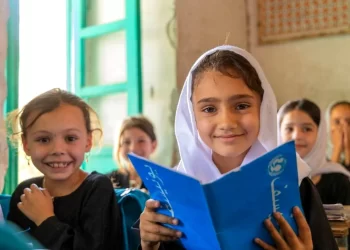
At a time when university doors remain closed to girls and women, and dreams are pushed aside before they can bloom, Maryam Tamoori’s story reveals the quiet resilience of a woman who creates meaning out of deprivation. It is the story of a girl who walked toward Kabul University with midnight coffees, worn books, and hope in her hands, only to receive two brief walks along its sidewalks in return. Even so, Maryam did not surrender or bury her dreams. She wrote, she read, she worked, and she kept her aspirations alive in a different form.
Maryam believes that wishing is a beautiful thing. Yet when a person wants something deeply, struggles for it, fights for it, and still fails to reach it, that loss becomes a more refined form of death. She remembers that four years ago, determined to escape ignorance and unawareness, she made a promise to herself to one day become a skilled journalist and writer.
She explains that entering Kabul University was the dream of many girls, and she reached it only after endless worries and hardship. She succeeded in gaining admission to the Department of Turkish Literature at Kabul University. She says, “I remember spending the money meant for my Eid clothes on exam preparation books. I turned social gatherings into something bitter for myself, and my arms were always filled with books. I memorized and reviewed them again and again until, week after week, I filled the answer sheets exactly as required. Then came the daydream of entering Kabul University. Those efforts were not lonely, illusory, or transformative. They were simply thirst, a thirst to learn the beloved world of literature.”
She continues, “Late-night coffees, staying awake until morning, seeking refuge in history and geography, memorizing sine and cosine formulas, and drawing right triangles to understand tangent and cotangent are all memories I have never doubted. One by one, they came together and led me to Kabul University. Yet I only managed to go there twice. I still remember walking eagerly, step by step, along the university sidewalks. I had not reached the end of my dreams, because the length of my aspirations stretched far beyond those paths.”
Maryam explains that writing felt like the only way she could allow her words to grow in today’s noisy world. Through journalism, she believed she could take part in telling the stories of that world.
She says, “At first, I wanted to study literature at university, read endlessly, and memorize everything about writers who have left behind nothing but ink and handwriting. I imagined the houses of Izmir, the streets of Istanbul, and the memories of Ankara. I wanted to seek refuge in Ottoman Turkish literature, in the works of Khalid Ziya that became masterpieces and reached the cinema, in the words of Nazim Hikmet and Yaşar Kemal, and in the sharp humor and debates shaped by Aziz Nesin. But all of this remained an idea in my mind, a wish in my heart, and a quiet longing that stayed in a corner of my mother’s notebook of dreams, the dream that her daughter would one day study Turkish literature at Kabul University.”
Maryam says that thirteen years have passed since she began writing her stories. During this time, she has read more novels and taken refuge in literature. Still, studying literature, especially at Kabul University, remains her most cherished dream.
She says that this year she once again hears the joyful noise of boys preparing to graduate from university, yet she does not feel upset. She explains, “I am not sad, and no jealousy has taken hold of me. I am not disappointed in myself either, because disappointment is a mature form of surrender, and I do not recognize myself in that word. I do not cry. My tears must remain distant. I dislike crying because it does not suit me. Crying signals weakness and often becomes a foolish way to seek attention. I hold no bitterness toward the success of others. In these four years, I have not planted the seeds of dead dreams anywhere. Instead, I have worked in media, written different novels, and read books that feel, to me, like burying my disappointments. Still, one strange feeling remains with me.”
You can read the Persian version of this report here: