
With the increasing use of vehicles and population growth, road traffic management has become one of the key issues in ensuring public security and order. In most countries, the responsibility for regulating road traffic lies with public order and law enforcement forces (the police).
Afghanistan is among the countries that, at least over the past half-century, have included road traffic police departments within the structure of its police to regulate road traffic. To this day, the General Directorate of Traffic Police operates nationwide, with provincial traffic police directorates active in each province. However, the management approach and the emphasis on specialization and capacity-building within this department have faced many ups and downs. Due to various reasons, Afghanistan has not been able to establish an effective management system for road traffic.
With the Taliban in power, who generally do not believe in specialization or entrusting tasks to experts, this critical department, like other police departments, faces numerous human and technical capacity challenges. This article seeks to address various dimensions of this critical issue and examine the current capacities of the Taliban administration and their consequences for the people of Afghanistan.
Traffic accidents are a significant global issue, causing substantial human casualties and financial losses every year. International statistics indicate that at least 1.19 million people lose their lives annually in traffic accidents, it is estimated that road injuries will impose a global economic burden of $1.8 trillion (in constant 2010 US$) between 2015 and 2030, equating to an annual cost equivalent to 0.12% of the world’s GDP. In Afghanistan, the lack of a unified database for recording human casualties from traffic accidents makes it difficult to provide accurate statistics. However, during my tenure as Director General of Strategy at the Ministry of Interior, while compiling provincial profiles for Afghanistan, I encountered alarming statistics on traffic-related fatalities provided by the General Directorate of Traffic Police. According to these statistics (2010-2019), an average of 1,200 people lost their lives annually in traffic accidents across Afghanistan.
The issue of highway security and management has been a long-standing challenge in Afghanistan through various periods. Due to insecurity and the vulnerability of responsible forces, minimal control has been exercised over the status of key economic highways vital for the country’s trade. These highways have often been sites of illegal activities by both citizens and anti-government forces. Our evaluations at the time indicated that the most severe traffic accidents occurred on Afghanistan’s highways, where the highest numbers of human casualties were also recorded. The main factors identified for these accidents included the destruction of road infrastructure (roads, bridges, and culverts) due to Taliban terrorist activities, the lack of traffic signs, driving under poor mental conditions such as sleep deprivation, drug or alcohol use by drivers, prolonged driving, speeding, vehicle overloading, and administrative corruption in issuing driving licenses.
On the other hand, during the early years of the Republic, the Ministry of Interior briefly established an organized structure to ensure the security of highways across Afghanistan. This initiative facilitated the presence of traffic police and their patrols for control. However, due to various political reasons and allegations of extortion from vehicles and occasionally involvement in drug trafficking, this structure was dissolved. Subsequently, there was no independent authority directly responsible for securing highways in Afghanistan, except in some provinces where police units at the platoon or company level operated to maintain highway security. Consequently, Afghanistan’s highways turned into death traps for citizens in terms of security and traffic incidents, becoming safe havens for drug smugglers and terrorists.
Our team’s investigations at the time revealed that no dedicated traffic police force existed across Afghanistan to regulate road traffic on highways. Traffic management officials in each province, despite a lack of personnel and resources, were responsible for handling traffic issues on the highways within their jurisdictions. I personally raised this issue multiple times in reports and discussions during strategy and planning meetings for the national police. However, due to a lack of resources in the organizational structure and a lack of interest from international supporters in providing resources, we were unable to resolve this critical challenge at the strategic level.
Nonetheless, at least during the Republic period, unlike the current situation, there was a willingness to address this issue, with efforts being made at various levels. However, under the current Taliban regime, there is no will to address this vital issue. The Taliban have minimal belief in specialization or addressing critical national issues like road traffic regulation. After the Taliban came to power, most trained personnel specializing in traffic management, educated at the police academy and other domestic and international institutions, were dismissed and replaced by Taliban members who had no experience or knowledge in this field.
The management structure of traffic police departments has turned into religious schools. To obtain a driving license, the fundamental requirement is the recitation of travel prayers rather than technical or practical skills. The Kabul Traffic Police Chief, a Taliban member reportedly a former baker in Peshawar, has repeatedly been observed asking applicants to recite travel and mosque prayers as conditions for obtaining a license. In one of his statements, he said, “You must memorize travel prayers, mosque entry and exit prayers, and know how to perform ablution.” In another video, he asks everyone simple questions such as “apply the brake,” “use the horn,” and then says, “You pass, Mashallah.”
Despite the poor condition of Afghanistan’s roads, particularly due to Taliban-planted explosives over two decades to target Afghan security and defense forces and international forces, the Taliban leader has ordered the construction of a large mosque every 70 kilometers on highways. This indicates that the Taliban have no program or commitment to address this critical national issue.
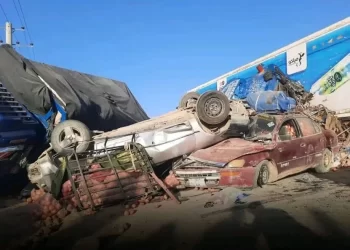
Last week, two deadly traffic accidents occurred in Ghazni province, resulting in 64 deaths and over 60 injuries, according to available information. Initially, media reports indicated that 52 people had been killed. Given the fatalities and the resulting situation, this could be considered a catastrophe in the management of road traffic in Afghanistan. The daily Hasht-e-Subh also reported that in the last three months, 190 Afghanistan citizens have lost their lives in traffic accidents. Despite the Taliban’s claims of having shut down some transportation companies, no effective measures have been taken by this group in this regard.
Factors such as damaged transportation infrastructure, lack of oversight of driver health and vehicle safety, drug use by heavy vehicle drivers, speeding, prolonged driving under psychological stress, failure to use safety equipment such as seat belts, and vehicle overloading are among the main causes of these deadly accidents on Afghanistan’s highways and in its cities. Furthermore, the absence of facilities for post-accident health services and the remote location of highways from provincial and district centers contribute to increasing human casualties. The Taliban’s lack of will and resources adds to this problem.
Instead of addressing the threats endangering people’s lives on Afghanistan’s roads, the Taliban has implemented measures unrelated to traffic regulation. They compel citizens to paint their vehicles according to their preferences. Some reports indicate that Taliban members in the Traffic Police Directorate have monopolized painting programs for their associates and force people to repaint their vehicles at designated centers.
The Taliban have no traffic control stations or patrol units to regulate traffic flow on any of Afghanistan’s highways. All Taliban traffic police structures are concentrated in cities and focus not on regulating traffic but on extorting money from people and harassing them. Numerous images shared by citizens show that the Taliban when inspecting vehicles, pay no attention to mechanical defects or driver health. Instead, they look for issues such as women traveling without a male guardian, passengers without beards, or individuals not wearing hats. The Taliban have often punished drivers for transporting women without Mahram (male guardians) or for playing music but have not penalized speeding overloading, or technical faults.
The group has established checkpoints at city entrances with two primary missions: 1) collecting money under various pretexts such as transit fees and religious taxes and 2) inspecting people’s appearances to ensure compliance with Taliban standards and enforcing gender segregation.
On the other hand, corruption is one of the serious and significant issues that have become much more widespread in the Taliban’s traffic police departments compared to the Republic era, operating without public oversight. In an investigative report published by Etilaat Roz newspaper in 2022, it was revealed that the Taliban’s General Director of Traffic had appointed over 60 family members and relatives to positions within this directorate. Furthermore, contrary to their leadership’s directives and in the absence of international driving licenses, they issued licenses to several women in exchange for money.
Appointments in this department, like other agencies under the Taliban regime, are not based on administrative principles and transparency but are carried out through personal connections and verbal recommendations. No oversight exists regarding recruitment practices in this area.
Conclusion
As discussed in this paper, road traffic management and regulation have become one of the biggest challenges for maintaining public order in Afghanistan, especially under the current circumstances where the Taliban hold power. Due to managerial inefficiencies, administrative corruption, and the lack of coherent planning, this issue has gone beyond the group’s control. The lack of sufficient oversight, inadequate infrastructure, and the resulting increase in fatalities and financial damages have significantly undermined public trust in the government.
Furthermore, the abolition of the special highway security structure established in the early Republic period has led to Afghanistan highways becoming dangerous routes for the public and secure locations for drug smugglers and terrorist groups. These highways have lost their crucial role in supporting trade and the national economy. The absence of responsible structures and sustainable programs to secure roads has not only increased traffic accidents but also disrupted the ability to utilize highways for the benefit of the national economy.
Therefore, all relevant parties, including citizens, the private sector, and especially owners of freight and passenger vehicles, must address this issue as a serious security matter. Their involvement and cooperation with responsible authorities can help improve monitoring and reduce road hazards.
In the post-Taliban era, rebuilding and strengthening the special highway security structure and enhancing the capacity of traffic police must be considered a key priority for Afghanistan. This rebuilding requires the development of modern structures, the use of advanced technologies, and the formulation of comprehensive and transparent laws. Only through this approach can road accidents and disasters be prevented, ensuring the safety of citizens and creating secure highways to support trade and the national economy.
If this issue is not treated as a national priority, not only will the lives of thousands of Afghanistan citizens remain at risk, but all efforts for economic reconstruction will face significant challenges due to the lack of safe and efficient highways. Therefore, comprehensive cooperation between domestic institutions, the private sector, and the international community is an undeniable necessity for creating a sustainable and effective system for managing traffic and road security in Afghanistan.
You can read the Persian version of this article here:
حوادث ترافیکی در افغانستان؛ ناتوانی طالبان در ایجاد نظم و امنیت جادهای | روزنامه ۸صبح