• 8AM.MEDIA
  • ویب‌سایت فارسی
  • پښتو ویب‌پاڼه
  • اۉزبېکچه ویب‌سایت
  • Podcast
Friday, October 23, 2026
Hasht-e Subh
  • Home
  • News
    • Afghanistan News
    • World News
  • Opinion
    • Editorial
    • Analysis
  • Reports
    • Daily Reports
    • Investigative Reports
  • Society
    • The story of people
  • Women’s Word
  • Columns
    • Three Years After Afghanistan’s Fall: The Taliban’s Resurgence
    • Towards Equality
    • The Resurgence of the Taliban: Two Years Since Afghanistan’s Fall
    • Hebatullah Report Special Edition
    • Resistance for Education Special Edition
    • Special Column on Taliban’s Education Curriculum
    • Nawroz
  • Interviews
  • Contact Us
    • About Us
    • 8AM MEDIA Annual Awards
    • Submit an Article to Hasht-e-Subh
  • 8am.mediaBack
Subscribe
No Result
View All Result
  • Home
  • News
    • Afghanistan News
    • World News
  • Opinion
    • Editorial
    • Analysis
  • Reports
    • Daily Reports
    • Investigative Reports
  • Society
    • The story of people
  • Women’s Word
  • Columns
    • Three Years After Afghanistan’s Fall: The Taliban’s Resurgence
    • Towards Equality
    • The Resurgence of the Taliban: Two Years Since Afghanistan’s Fall
    • Hebatullah Report Special Edition
    • Resistance for Education Special Edition
    • Special Column on Taliban’s Education Curriculum
    • Nawroz
  • Interviews
  • Contact Us
    • About Us
    • 8AM MEDIA Annual Awards
    • Submit an Article to Hasht-e-Subh
  • 8am.mediaBack
No Result
View All Result
Hasht-e Subh
No Result
View All Result

Why We Must Talk About Men’s Literacy

Khorshid Khorshid
18 June 2025 - Solar Hijri Date: 1404/03/28 [t_time:1750268449]
A group of men walks through a bustling street in Afghanistan, showcasing everyday life in the region. (Photo Credit: AFP)

AFP

Whenever I speak about International Women’s Day or any day dedicated to women, I don’t want to simply offer the usual greetings or repeat hollow slogans. I want to talk about the realities that shape a woman’s life, every single day. These truths are not found in books or broadcast in the media—they live in our alleys, our homes, and in the intimate moments of our daily existence. The turbulent state of our society, in every dimension, demands dialogue and a shift in dominant narratives. And here, I want to focus on two long-standing concerns of mine: literacy and awareness.

Let me begin with a simple yet provocative question: whose literacy matters more—women’s or men’s? In both the past and present, international organizations, political and financial supporters of Afghanistan, and global advocacy platforms have repeatedly emphasized the importance of women’s education. Large and costly initiatives have aimed to build schools in both urban and remote areas, designed to encourage girls to pursue education. But here’s the reality: we cannot build an educated, dynamic, and free society if only half of the population, women, become literate, while the other half, men, remain steeped in ignorance and prejudice.

To date, few have paid serious attention to the importance of male literacy in Afghanistan, although it can, in many cases, prove to be even more decisive than female literacy. Amartya Sen, the Nobel-winning economist and human development theorist, argued that literacy is not merely a personal tool but a foundational element in expanding human freedoms. And these freedoms are only meaningful when both women and men have access to knowledge, awareness, and intellectual capacity. By “literacy,” I don’t mean only the basic ability to read and write. I mean awareness. UNESCO, too, has long emphasized this broader definition.

What happens when a woman is educated, but the men in her household—her father, husband, or brother—continue to think and act based on deeply entrenched patriarchal beliefs? In such cases, not only is the woman unable to make decisions for herself, but she may also lack the power to defend her daughter’s right to education. A man who lacks awareness does not understand the logic of growth and change. To him, a girl’s education equals a threat to his honor—a violation of family “virtue,” or what is commonly labeled as be (“dishonor”) or “shamelessness.

A few days ago, I came across a speech by a mullah who has been active under both the previous and current regimes. He is educated and commands the attention of hundreds every Friday during his sermons. In our society, mullahs hold significant social authority. People listen to them. They respect their words. So, imagine the influence of a mullah who is not only educated but also raised in a family that values awareness. What kind of transformative effect could such a figure have on society?

Men who lack education, awareness, and the ability to critically engage with social issues often become the primary obstacles to women’s progress. For many Afghan parents, marrying off their daughters seems like the only viable path, not supporting them through education and independence. An uneducated man doesn’t just carry traditional mindsets; he often reinforces and reproduces systemic gender discrimination. The result? Girls are denied education, and the cycle of ignorance continues from one generation to the next. But Afghanistan’s crisis isn’t just about a lack of education. It’s also about the way women are viewed. In many communities, women are still seen not as autonomous individuals, but as sexual beings or family property. Fathers, brothers, husbands—even teenage sons—consider themselves the rightful decision-makers over a woman’s life. They control how she dresses, where she goes, who she talks to, and how far she can study—if at all.

Where does this mentality come from? From ignorance. From a deep-rooted lack of literacy, of true awareness. A closer look reveals that gender inequality in Afghanistan isn’t merely a personal or familial issue; it’s a structural one. It is perpetuated by deeply embedded customs, traditions, and informal teachings. When a father or brother sees himself as a woman’s “guardian,” he is enacting a form of symbolic violence that society has normalized.

Today, Afghan women are rewriting the future with every step they take toward education, rights, and freedom. It is a daily struggle—not only against the Taliban, but also against entrenched traditions that have long taken root in our homes and culture. Everyone is alarmed that girls are being denied education, but few notice that, quietly, hundreds of thousands of Afghan boys are also slipping into the shadows of a deliberately imposed ignorance, designed to preserve a system built on inequality and unawareness.

Even if the Taliban were to disappear tomorrow, women would still be forced to fight against men whose minds remain stuck in the same old patterns. But if those same men were educated and aware, they would stand beside women and support their growth, not block it.

Yet there is little focus on boys’ education or on reforming university curricula for the current generation. I believe that just as educating girls is vital, educating boys is equally essential, because men are often the first barrier. It’s time we rethink our priorities. I understand that this change will require a sustained and long-term effort. But I firmly believe this: if, one day, conditions allow for universal education, then for at least two to three decades, our resources must be directed toward the proper education of Afghan boys and men. When that day comes, we will raise a generation of literate, conscious, and enlightened men—men who will inevitably reshape both the family unit and the broader society in profound ways.

So let’s begin by listening to one another—not merely as victims of the current regime or circumstance, but as forces for change. Let’s believe, together, that the fight for women’s rights requires educated men—and that we don’t need to build walls between women and men to achieve equality. Without dividing lines, our struggle will bear fruit—not just for me or you, but for all of us.


You can read the Persian version of this analysis here:
چرا باید از ضرورت «سواد» مردان حرف بزنیم؟

ShareTweetSendSendShare

Related Posts

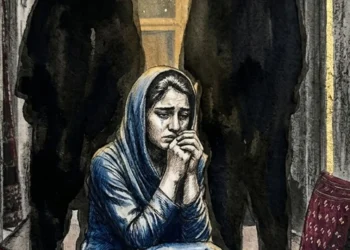
A young woman in a blue headscarf sits in a dim room with her hands clasped to her face, tears on her cheek, as psychologists warn of family pressure on girls. (Photo credit: AI)
Daily Reports

Gender Discrimination in Afghanistan: Family Pressure Pushing Girls to the Brink of Psychological Collapse, Psychologists Warn

11 October 2026 [t_time:1791724163]
A stand banner of the World Health Organization (WHO) is displayed at its central office. (Photo credit: WHO)
Afghanistan News

WHO Raises Awareness to Prevent Botulism Outbreaks in Affected Areas

30 September 2026 [t_time:1790762649]
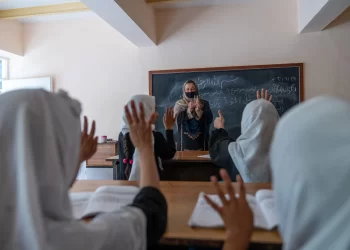
Students attend a literacy class as a teacher leads a lesson in a classroom in Afghanistan. (Photo credit: X/EUinAfghanistan)
Afghanistan News

EU Allocates Nearly €5 Million to Support Literacy in Afghanistan

8 September 2026 [t_time:1788884826]

Latest

Loading latest news...

Popular stories

  • Donald Trump – U.S. President with Benjamin Netanyahu – Israeli Prime Minister in a gathering of people (Photo: Getty Images) Donald Trump – U.S. President with Benjamin Netanyahu – Israeli Prime Minister in a gathering of people (Photo: Getty Images)

    US Senator Criticizes Netanyahu’s Remarks Justifying War Against Iran

    Share
    Share Tweet
  • US Defense Secretary Warns Iran of “Destruction”

    Share
    Share Tweet
  • UN Report Reveals Shifts in Family Attitudes and Rise in Domestic Violence in Afghanistan

    Share
    Share Tweet
  • Trump Calls Iran’s Hope of War Lasting Beyond US Midterm Elections a “Dream”

    Share
    Share Tweet
  • Iran’s Revolutionary Guards Say They Are Preparing to Unveil “Father of All Bombs”

    Share
    Share Tweet

Podcast

Insights
Insights

Join Lynne O’Donnell for 8AM’s podcast series, Insights.
Lynne talks with generals, diplomats, soldiers, journalists, politicians, activists, people who have front row seats for conflicts around the world, and citizens with a story to tell, happy or sad. For this first series, Afghanistan is the focus. Lynne and her guests talk about the collapse of the republic in August, 2021, and the impact since — for the people of Afghanistan, for the security of the region, for the safety of the world. It’s important, interesting and insightful.

Insights/22: Controlling the Narrative with Mina Sharif
byinsights8am

Controlling the Narrative

Lynne O’Donnell talks with Mina Sharif, author, activist, women’s rights campaigner, educator and mentor. They discuss who controls the narrative and who speaks for Afghanistan’s people when the Taliban appear to have seized control not only of the country but of the message, too.

Have a listen

Insights/22: Controlling the Narrative with Mina Sharif
Episode play icon
Insights/22: Controlling the Narrative with Mina Sharif
Episode Description
Episode play icon
Insights/21: Media Meltdown with Zahra Joya
Episode Description
Episode play icon
Insights/20: Terror Inc with Scott Richards
Episode Description
Episode play icon
Insights/19: Busting Stereotypes with Bushra Gohar
Episode Description
Episode play icon
Insights/18: Media Matters with Waliullah Rahmani
Episode Description
Episode play icon
Insights/17: What Goes Around Comes Around with Sima Samar
Episode Description
Search Results placeholder
Hasht-e Subh

8AM Media, also known as Hasht-e-Subh Daily, stands as Afghanistan's premier independent and non-profit newspaper, resonating as a beacon of journalistic integrity since its establishment in June 2007 by esteemed Afghan journalists and human rights advocates. With a steadfast commitment to citizen journalism and civic education, Hasht-e-Subh Daily has earned its place as the most esteemed publication in the nation.

Publisher: Sanjar Sohail
Email: [email protected]
Executive Director: Parwiz Kawa
Email: [email protected]

Read More

Has the World Grown Accustomed to the Crisis in Afghanistan?

International Criminal Court Wins Sakharov Prize for Freedom of Thought

Guterres Calls for an End to Conflicts Worldwide

UNICEF: Millions of Children in Afghanistan Face Climate Risks

From the Shadows to Finding My Voice: A Story of Struggle and Resilience

Editor’s Choice

Every Saturday morning, 8AM MEDIA English Services Department will guide you through the week’s biggest stories from Afghanistan and the international community.

Subscribe

© 2026 - ©Hasht-e Subh Daily

No Result
View All Result
8am.Media
پښتو ویب‌پاڼه
ویب‌سایت فارسی
اۉزبېکچه ویب‌سایت
  • Home
  • News
    • Afghanistan News
    • World News
  • Opinion
    • Editorial
    • Analysis
  • Reports
    • Daily Reports
    • Investigative Reports
  • Society
    • The story of people
  • Women’s Word
  • Columns
    • Three Years After Afghanistan’s Fall: The Taliban’s Resurgence
    • Towards Equality
    • The Resurgence of the Taliban: Two Years Since Afghanistan’s Fall
    • Hebatullah Report Special Edition
    • Resistance for Education Special Edition
    • Special Column on Taliban’s Education Curriculum
    • Nawroz
  • Interviews
  • Contact Us
    • About Us
    • 8AM MEDIA Annual Awards
    • Submit an Article to Hasht-e-Subh
  • 8am.media

© 2026 - ©Hasht-e Subh Daily