Introduction
Nation-state building, one of the most significant and fundamental principles for the survival and continuity of countries, does not have a long history in international relations. This concept emerged after the collapse of empires and the Westphalian order, leading to the formation of Nation-states, and entered the domain of political science (1). In Afghanistan, however, the first foundation of Nation-state building was laid 140 years ago by King Abdur Rahman. This process, from its inception, was flawed, and instead of building a state based on law and citizens, it pursued genocide and cleansing. Instead of nation-building, it sought homogenization and assimilation (2). Now, 140 years later, Afghanistan has undergone several attempts to achieve a national identity and build a national state. However, Afghanistan’s diverse, mosaic-like society still faces a severe crisis of national identity and statehood, suffering daily from the failures of this process, paying the price in blood and resources.
The last efforts toward post-2001 Nation-state building in Afghanistan, led by the United States and engineered by UN representative Lakhdar Brahimi, James Dobbins, and Zalmay Khalilzad, began. Among them, Brahimi and Dobbins, as experienced diplomats, had notable track records. Brahimi had experience managing crises in the Middle East, and Dobbins had an illustrious career in nation-building in post-World War II Germany and Japan, as well as in Kosovo, Bosnia, Herzegovina, Haiti, Somalia, and Iraq (3). However, Zalmay Khalilzad, an Afghan-American who was appointed as the U.S. special envoy for Afghanistan by President George W. Bush’s administration at the time, lacked much experience. Despite this, he played the most significant role in forming transitional, interim governments, the constitution, and the political system of post-2001 Afghanistan. He sometimes acted as a shadow president, and both Afghan presidents, Hamid Karzai and Ashraf Ghani, sought his counsel. Khalilzad’s influence can be traced from the Bonn Conference in Germany, which led to the formation of a flawed government in Afghanistan, to the Doha Conference in Qatar, which resulted in the collapse of the Republic, the disastrous U.S. withdrawal, and the return of the Taliban and al-Qaeda to power in Afghanistan. Today, Afghanistan finds itself in a situation reminiscent of pre-2001. Sometimes, it feels like history is standing still, or that we have been thrown back two decades. In this analytical article, I will address the questions of why the 20-year efforts and massive investments of the international community and the U.S. in Nation-state building in Afghanistan failed, and what role American officials, particularly Zalmay Khalilzad, played in this historic failure of both America and Afghanistan. Our research method in this analytical note is based on library and journalistic sources
Getting to Know Khalilzad
Khalilzad is one of the most recognizable figures in Afghanistan’s political landscape over the past four decades, from the Cold War to the disastrous U.S. exit from Afghanistan. However, to better understand and clarify his actions and career, it is necessary to delve into his life so that readers can gain a clearer picture of him.
Zalmay Khalilzad was born in March 1951 to a Pashtun father and a Tajik mother in Balkh province, Afghanistan. His father, from the Nurzai tribe, was a government official during King Mohammad Zahir Shah’s reign and was stationed in Balkh, where he remained. Khalilzad completed his high school education at Ghazi High School in Kabul and later emigrated to the U.S. as part of a cultural exchange program, attending Cros College in California. He then earned his bachelor’s and master’s degrees from the American University of Beirut in Lebanon, and his Ph.D. from the University of Chicago in the United States (4). While studying in Beirut, Khalilzad married Cheryl Benard, an Austrian woman. His eldest son, Alexander Benard, is the CEO of the oil company Gryphon. According to Radio Free Europe, in 2011, Alexander’s oil company failed to win a bid to extract oil from the Amu river basin in northern Afghanistan, losing to a Chinese company, CNPC, which secured the multi-billion-dollar contract.
At the time, Alexander Benard sharply criticized his company’s failure and the Chinese success in an article published in Foreign Policy magazine.
Khalilzad and his family’s connections to major global oil companies date back to the late 1990s, after the end of the Cold War. Khalilzad was a consultant for Unocal Corporation, a global oil giant that sought to transport gas and oil from Central Asian countries, particularly Turkmenistan, through Afghanistan and Pakistan to India and, eventually, to open seas for sale. This major project, called “TAPI,” has been in the works for over 30 years. Khalilzad viewed the Taliban as ideal soldiers to protect this large project (5). Khalilzad’s ties to the Taliban, aside from Pashtunwali, stem from this project. Several times in the past two decades, the governments involved in this project have attempted to start the practical work, but due to insecurity in Afghanistan, it hasn’t been realized. The 850 kilometers of the TAPI pipeline that passes through Afghanistan, particularly through the insecure southern regions, remains a challenge. Now, the Taliban have once again launched the project, and it seems that its implementation may be part of Khalilzad’s trade agreement with the Taliban in Doha.
Beyond this, former Vice President of Afghanistan, Amrullah Saleh, exposed Khalilzad’s business relationship with Mirwais Azizi Hotak, the owner of Azizi Bank and the Azizi Group of Companies, an Afghan billionaire who is currently building the second tallest skyscraper in the UAE. It is said that a significant portion of Azizi’s wealth belongs to Khalilzad.
The Failure of U.S. State-Building in Afghanistan
Afghanistan is among countries with high levels of ethnic-religious diversity, conflict, and division, particularly in the last half-century. After the 2001 transformations, it was expected that influential internal and external actors shaping the country’s politics would reach a consensus on a political structure and constitution that would reflect Afghanistan’s multi-ethnic reality, ensuring lasting peace and security, while also setting the country on the development path.
However, the post-Bonn political architects, especially Zalmay Khalilzad, the most influential Afghan-American figure, designed and implemented a constitution and political structure influenced by Pashtun ethnic biases and the Pashtunwali culture, tailoring a system for Afghanistan that was ill-fitting from the start.
Historically, it had been proven that Afghanistan, given its internal conflicts over political power, could no longer be governed through a centralized, Pashtun-dominated political structure. Nevertheless, the triangle of Khalilzad, Karzai, and Jalali, a technocratic and ethnic-chauvinistic circle, pressured the system to enshrine an absolute centralized presidential system in the new 2004 constitution (7). This flawed political structure faced major challenges from the outset, was inadequate for Afghanistan’s political needs, and pushed the country into a future disaster.
The collapse of the Fourth Republic and the failure of the post-Bonn Nation-state building process led many Afghanistan experts, including James Dobbins, one of the architects of the new Afghanistan, to conclude that the biggest strategic mistake of the Bush administration and its special envoy, Khalilzad, in Afghanistan was the blind and erroneous implementation of an American model of centralized governance. Dobbins believes that a presidential system and majority rule democracy did not match Afghanistan’s mosaic-like society, ultimately leading to catastrophic failures that Dobbins described as one of the most deadly and strategic mistakes of the U.S. in Afghanistan (8). Therefore, it can be concluded that Khalilzad’s ethnic-driven views, his manipulation of the constitution, and the imposition of a failed and outdated structure led to the failure of state-building and the waste of billions of American taxpayer dollars in Afghanistan, leaving the country in its worst historical and humanitarian state, for which Khalilzad is the main culprit.
The Failure of U.S. Nation-Building in Afghanistan
Similarly, nation-building in Afghanistan remains flawed. Dr. Mohsen Khalili, a renowned Iranian expert, notes, “Afghanistan is a pre-nation and pre-state country.” The reality is that Afghanistan has faced a national identity crisis throughout history, especially in the last century. The term “Afghan,” which is supposed to represent national identity, is an ethnic, not a national identity. This term is synonymous with the Pashtun ethnicity, and other ethnic identities such as Tajiks, Uzbeks, Hazaras, Aimaqs, and others do not see themselves reflected in this identity.
Instead of nation-building, Afghanistan has long pursued a policy of ethnic homogenization, upsetting the social fabric of particular regions, especially in the north, the historical homeland of the Tajiks.
It was expected that after the opportunities presented in the past 20 years, a logical and fair solution to this crisis would be found. However, the ethnic supremacism and the illusion of ethnic majority, along with Khalilzad’s lobbying efforts, prevented the resolution of this issue, even though the law on national identity registration, which passed the Afghan parliament in 2013, could have put an end to the national identity crisis.
Ethnic nationalists, particularly Khalilzad and Ashraf Ghani, bypassed the law and resumed ethnic homogenization instead of nation-building. Khalilzad played a role in assisting Ghani in this matter.
In this regard, Greg Whitlock, an American journalist who recently authored a book titled “The Afghanistan Papers”, emphasizes that “the U.S. model for nation-building in post-Bonn Afghanistan was flawed and erroneous, ultimately leading to the collapse and failure of the political system in the country” (10).
The Doha Agreement and the Catastrophic Withdrawal
The appointment of Zalmay Khalilzad, an American of Pashtun origin, as the U.S. Special Representative for Peace Talks with the Taliban in September 2018 was a hasty and strategic historical mistake by the Trump administration. The mistake lies in the fact that Khalilzad had previously failed in U.S. nation-building efforts in Afghanistan and had a poor track record. He should not have been selected as the one to end the 20-year conflict and the longest U.S. foreign war in Afghanistan. The 20-year experience of U.S. presence in Afghanistan, the failure of nation-building, and the deadlock in the war with the Taliban had revealed that American officials, including Khalilzad, the chief architect of the new Afghan government, had not succeeded and had made significant mistakes. This ultimately led to the hasty, humiliating, catastrophic, and costly withdrawal of U.S. forces, the collapse of the Afghan Republic, and the return of the Taliban to power.
With the blank check provided by the Trump administration for negotiations with the Taliban, Khalilzad repeatedly visited Afghanistan’s neighboring countries and engaged in direct talks with Pakistan, which was the Taliban’s supporter and patron state. He facilitated the release of several Taliban leaders for negotiations, including Mullah Baradar, who signed the 2020 Doha Agreement with U.S. Secretary of State Mike Pompeo, from Pakistani prisons, as well as from Bagram and Guantanamo. By starting direct negotiations with the Taliban, he bypassed the Afghan government. This move dealt the final blow to the already weakened Kabul administration, which was suffering from a lack of legitimacy due to accusations of electoral fraud.
Furthermore, Khalilzad’s insistence on the unconditional release of over 5,000 Taliban prisoners from Afghan jails in the months leading up to the catastrophic U.S. withdrawal and the fall of the Republic strengthened the Taliban’s military machinery. From the outset, it was evident that by sidelining the Afghan government, the Taliban would steer Afghanistan’s future.
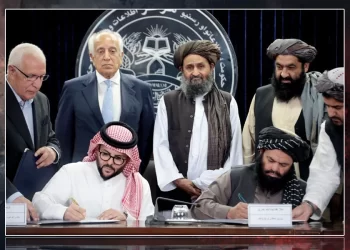
Ultimately, after nine rounds of talks, the U.S. and the Taliban agreed to the Doha Agreement in February 2020, a deal that had only one winner: the Taliban. In this way, Khalilzad handed over the keys to the Afghan Presidential Palace to Mullah Baradar. This perspective on Khalilzad’s destructive role is not only my analysis. Many American political figures agree with me, including John Bolton, the National Security Advisor, and Robert Grenier, the former CIA station chief, both of whom have analyzed the catastrophic U.S. withdrawal and the collapse of the Afghan government over the past three years, holding Khalilzad responsible for the situation (11).
Conclusion
In conclusion, many factors contributed to the failure of U.S. nation-building in Afghanistan, the stalemate in the country’s historical war against terrorism and al-Qaeda, the flight of President Ghani, and the hasty, catastrophic withdrawal of U.S. soldiers, which ultimately led to the collapse of the Afghan government and the Taliban’s entry into Kabul in August 2021. Among these factors, the role of U.S. officials, particularly Zalmay Khalilzad, is more prominent. Khalilzad played a greater role than any other domestic or foreign actor in the return of the Taliban to power, the fall of the Republic, and the historical failure of the U.S. in Afghanistan.
Now, more than three years after that historic failure, Afghanistan is in its worst humanitarian situation. Widespread poverty and hunger, the collapse of the economy, political and security instability, mass migration, the absence of a legitimate government, increasing threats and security vulnerabilities, and the presence and activities of more than 20 terrorist and radical Islamic groups, including al-Qaeda, are thriving under the rule of an intensely totalitarian, authoritarian, and ethnically-driven movement with a rigid and distorted interpretation of Islam, turning the country into a living hell for its citizens, particularly its women.
Therefore, the findings of this article demonstrate that Khalilzad bears a significant share of the blame for this misery, crisis, and the historical humiliation of the United States on the global stage. In short, Khalilzad sacrificed the efforts, costs, and bloodshed of thousands of American soldiers over the past two decades in Afghanistan for his ethnic, tribal, and economic interests. He not only destroyed the opportunity for state-building in Afghanistan but also wasted the sacrifices of hundreds of thousands of Afghans. I firmly believe that had anyone other than Khalilzad been in his position, such a gamble would not have been taken, and the U.S. would not have faced such a fate and historical disgrace. Afghanistan and its people would not be in the dire historical situation they find themselves in now.
In conclusion, I close this article with two recommendations to the U.S. government:
First, before it’s too late, it should address the extremely dangerous and critical situation in Afghanistan and take the warnings seriously to correct its mistakes. Second, based on my understanding of the region, I know that Afghanistan still holds geopolitical significance in U.S. foreign policy. Whether now or in the future, the U.S. will remain one of the influential countries in Afghanistan’s affairs. Therefore, it should appoint individuals as ambassadors and special representatives in Afghanistan who have a deep understanding of Afghan society and consider the interests of both countries’ peoples. Not someone like Zalmay Khalilzad, who sacrifices everything for his ethnic and personal interests.
Sources:
- Biroun Hente (1400), “Thinking about Development”, Tehran: Pegah Roozegar No Publications.
- Hamza Wa’zi (1390), “An Introduction to Afghanistan’s Geopolitics”, Afghanistan Geopolitical Society: Mashhad, Badakhshan Publications.
- James Dobbins (1393), “Nation-Building in Post-Taliban Afghanistan”, Kabul: Center for Peace and Development Studies.
- Zalmay Khalilzad (1396), “Envoy: From Kabul to the White House”, Saint Martin’s Press.
- Greg Whitlock (1401), “The Afghanistan Papers”, Tehran: Kooleh Poshtee Publications.
- Yahya Mousavi (1402), “From Conquest to Collapse”, Mashhad: Sepideh Bavaran Publications.
- Mohsen Khalili (1401), “Pre-National, Non-State Afghanistan”, Badakhshan Publications.
- Hassan Abbas (1402), “The Taliban’s Return”, Tehran: Thalith Publications.
- Sputnik News Agency.
- “Foreign Policy” Magazine.
- Rasik News Agency.
You can read the Persian version of this analysis here:
بررسی نقش زلمی خلیلزاد در شکست دولتـملتسازی افغانستان | روزنامه ۸صبح