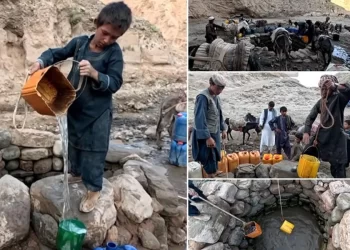

Residents of Kabul express growing concern over the declining water levels and the emerging water crisis in the city. They report that, in addition to dwindling water resources, the poor quality of available water poses a significant challenge, forcing many to rely on private mobile water companies to secure drinking water. Access to clean drinking water, coupled with poverty and unemployment, has become a fundamental issue for Kabul’s residents.
Several Kabul residents facing a severe water shortage state that the decreasing water levels and their poor quality have caused significant difficulties, leaving them deeply worried about the future.
Ali (pseudonym), a resident of the Karte Char area in Kabul, voices concerns about the declining water levels in his neighborhood. In an interview with the Hasht-e Subh Daily, he says, “We used to have a 40-meter well in our yard, which was sufficient. A few years later, that well dried up, so we dug another one, 90 meters deep. But for the past two years, even that well has run dry, and in just seven years, the water level has dropped several times over.”
He adds, “A critical issue that needs attention is the overuse of groundwater. For instance, in high-rise buildings, kitchens and bathrooms are supplied from a shared storage tank, typically filled with fresh groundwater. In areas where untreated water is available, it should be used for bathrooms in high-rise buildings.”
Samira (pseudonym) remarks, “The tap water is there, but it’s not for drinking. We use well water, but if there’s no electricity, there’s no water either.”
Beyond the scarcity and declining groundwater levels, the lack of confidence in the water’s safety and visible contamination are among the challenges pushing Kabul residents to turn to private companies for their water needs.
Shabir (pseudonym), another resident of Karte Char, says, “Tap water often has an unpleasant taste and smell, so we buy purified water from private companies.”
Mursal, another resident, notes, “Purified water tastes better and is clean. We only use city tap water for washing clothes and dishes.”
Sohrab, a resident of Kabul’s 11th district, says, “Our yard’s well, about 120 meters deep, dried up due to falling water levels. When we added pipes and deepened the well, it produced water, but it was muddy and unusable.”
He adds, “City tap water comes once a week, very weakly—sometimes it takes an hour to fill a 10-liter bucket. The amount is too little, especially for families with more than 10 members.”
Kabul residents say that, as families grapple with unemployment, declining incomes, and rising poverty, the increasing cost of water has further exacerbated their challenges.
Negina (pseudonym), a resident of the Gulai Cinema area in Kabul, says she spends over 1,000 Afghanis monthly on water. She adds, “In summer, tap water comes once a week, and in winter, twice a week. Generally, we don’t use government tap water for drinking because it has an unpleasant taste and we’re not confident about its safety. If tap water is sufficient, we spend between 1,200 and 1,500 Afghanis on drinking water. But when water is scarce, the cost of buying water in a month exceeds 3,000 Afghanis, which usually happens in summer.”
Saddam, facing similar issues, says, “My family has 12 members. If city tap water comes regularly and is sufficient, we spend 1,200 Afghanis monthly on bottled water for drinking. But when water is scarce, which often happens in summer, without bottled water, I have to buy water for 300 Afghanis every two days.”
The United Nations Office for the Coordination of Humanitarian Affairs (OCHA) has warned of an escalating water crisis in Afghanistan. According to OCHA, rainfall levels in the country have been below average, raising serious concerns.
The International Committee of the Red Cross (ICRC) has also issued a warning about water shortages in Afghanistan. According to the ICRC, approximately 33 million people lack access to sufficient water. The committee’s findings indicate that four decades of armed conflict and climate change have created significant obstacles to water provision.
Population growth, the absence of regulations, poor management of private water trade, and the increasing digging of deep wells are said to have intensified the water crisis in Kabul.
You can read the Persian version of this report here:
کاهش و آلودهگی آبهای کابل؛ نگرانی شدید باشندهگان از بحران بیآبی | روزنامه ۸صبح