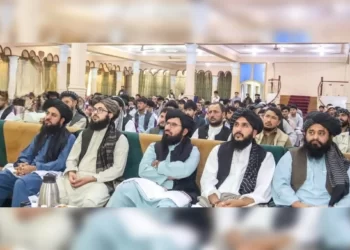

The human rights organization Rawadari recently issued a statement on the implications of the “Criminal Code of Taliban Courts” and warned that this code is deeply concerning and in clear violation of international human rights standards and the fundamental principles of fair trial. The statement notes that, among other things, the Taliban have legitimized slavery by repeatedly using the term “slave” in several sections. The organization also highlighted that the Taliban have classified Afghan Muslims into “Sunni and Jamaat” and “innovators,” a discriminatory categorization that not only creates inequality but also paves the way for widespread repression and arbitrary punishment of religious minorities. Rawadari stated that the “Criminal Code of Taliban Courts,” after being signed by Mullah Hibatullah, the supreme leader of the group, has been sent to provincial judicial institutions for implementation. The code is organized into three chapters, ten sections, and 119 articles.
In its statement, Rawadari expressed serious concern about the Taliban courts’ code, stating that it is in direct contradiction with international human rights standards and the fundamental principles of fair trial. According to the organization, the code formally and legally envisions discrimination against religious minorities and the suppression of fundamental freedoms, including violations of human dignity, freedom of expression and thought, and arbitrary detention and punishment.
According to Rawadari, the Taliban’s code does not comply with any basic standards of fair trial, including the principle of equality before the law, legality and personal responsibility for crimes and punishments, presumption of innocence, prohibition of torture, protection from arbitrary detention, the right to remain silent, and the right to an effective defense. The organization noted that nowhere in the code is the right to access a defense lawyer, the right to remain silent, or the right to compensation recognized, and other minimal requirements for a fair trial are not guaranteed.
The statement further noted that the Taliban’s code does not set minimum or maximum punishments and, by eliminating an independent investigation process to prove crimes, designates “confessions” and “testimony” as the primary means of establishing guilt. This significantly increases the risk of torture, severe abuse, and widespread violation of defendants’ rights.
Risk of Increased Discrimination and Suppression of Religious Freedoms
The organization stated that Article 2, Clause 8 of the Taliban courts’ criminal code describes followers of the Hanafi school as Muslims, while followers of other faiths and beliefs outside “Sunni and Jamaat” are labeled as “innovators” or heretics. According to Rawadari, this discriminatory classification in a country home to multiple religious minorities, including Twelver Shias, Ismailis, followers of other Islamic currents such as Ahl-e Hadith, as well as Sikhs and Hindus, directly violates the principle of non-discrimination based on religion. Rawadari added that labeling individuals as “innovators” and granting unlimited powers to Taliban judicial institutions enables widespread repression, deprivation of legal protection, and arbitrary punishment of religious minorities.
Rawadari further noted that Article 14 of the Taliban code allows, with the permission of the “Imam,” the killing of criminals to ensure “public benefit,” including those “who defend false beliefs contrary to Islam” or “those who invite others to these beliefs” (innovators and corrupters).
The organization also stated that Article 17, Clause 2, broadly criminalizes “mockery” and “derision” of Islamic rulings, prescribing a two-year prison sentence for offenders. According to Rawadari, this article provides no criteria for determining what constitutes “mockery” or “derision” and grants Taliban judges broad and arbitrary discretion to punish individuals simply for expressing differing or critical opinions.
Rawadari further highlighted that under Article 26 of the Taliban code, Hanafi followers are prohibited from leaving their religion and, if proven before a judge, face a two-year prison sentence. The organization emphasized that this ruling, which constitutes a clear violation of freedom of religion and belief, particularly endangers Salafis and Ahl-e Hadith adherents, exposing them to arbitrary detention, trial, and punishment, a serious concern given the Taliban’s treatment of these groups over the past four years.
Increase in Arbitrary Detention and Punishment
Rawadari stated that Article 2, Clause 11 of the Taliban code defines “rebels” as “corrupt actors” whose harm is public and “cannot be corrected without killing.” The organization stressed that this provision grants Taliban judicial and other institutions broad and dangerous authority to kill opponents, critics, and human rights activists under this label without guaranteeing the right to defense or a fair trial.
The statement added that Article 4, Clause 6, allows any Muslim “who sees sinners committing a sin” to punish them. According to Rawadari, this provision even grants ordinary individuals, Morality Police, and Taliban-aligned clerics the authority to punish others. Rawadari emphasized that these provisions seriously violate the rights to personal freedom and security, human dignity, protection from arbitrary detention and punishment, and the right to a fair trial.
Moreover, Article 2, Clause 14 specifies that in crimes subject to “Hudud and Diya” punishments, only the act itself is considered, and the offender’s character is disregarded. This approach is inconsistent with fair trial requirements, as criminal responsibility under legal standards requires consideration of the offender’s mental state, capacity, and intent. Ignoring this principle undermines fair trial guarantees.
Rawadari also noted that Article 59 criminalizes “dancing” and “watching it” without providing any clear, precise, or legal definition, violating the fundamental principles of legality and personal responsibility for crimes and punishments and presumption of innocence. Consequently, Taliban judicial authorities can arbitrarily deprive individuals of personal freedom and security, including for performing traditional dances that are part of their culture and way of life.
The organization emphasized that Article 13, with a vague reference and without a necessary explanation, permits the destruction of “places of corruption,” violating the principles of legality and personal responsibility for crimes and punishments, as well as the presumption of innocence. According to Rawadari, given the broad interpretation of “corruption,” this ruling could include establishments such as barbershops and beauty salons, punishing owners without proving personal responsibility.
Rawadari stated that under Article 40, any person present at a “corruption gathering,” even involuntarily and without a clear definition of “corruption,” is considered complicit and subject to punishment. This provision contradicts the principles of personal responsibility for crimes and punishments, as well as the presumption of innocence, because criminal liability is imposed without proving intent, awareness, or the role of the individual.
Recognition of Social Classification and Division into “Free” and “Slave”
Rawadari stated that while human dignity, equality of all people, non-discrimination, and the absolute prohibition of slavery are fundamental principles of human rights and part of the peremptory norms of international law, Article 9 of the Taliban courts’ criminal code effectively divides society into four categories: “scholars,” “nobility,” “middle class,” and “lower class.”
According to this article, the type and severity of punishment for the same crime are determined not by the nature of the offense but by the social status of the perpetrator. For example, if a religious scholar commits a crime, only a recommendation is issued; if a member of the nobility commits it, the response is limited to a court summons and recommendation. However, if the same crime is committed by a middle-class individual, imprisonment is imposed, and for members of the lower class, corporal punishment is applied in addition to imprisonment. This provision not only legitimizes the discriminatory concept of “social classification” but also directly violates the principles of equality before the law, prohibition of discrimination, proportionality of crime and punishment, and the prohibition of cruel and inhuman treatment.
The statement noted that the Taliban code legitimizes slavery by repeatedly using the term “slave” in several sections. For instance, Article 15 states: “For any crime for which a ‘Hud’ punishment is not specified, it shall be subject to Ta’zir, whether the perpetrator is free or a slave…” Additionally, Clause 5 of Article 4 specifies that the execution of “Hud” punishments is the responsibility of the “Imam,” while the execution of “Ta’zir” punishments can be carried out by the “husband” or “guardian.”
Rawadari emphasized that describing individuals as “free” and “slave” and explicitly using the term “slave” in the code constitutes recognition of a legal status that is absolutely prohibited and in clear conflict with equality, human dignity, and all fundamental human rights standards. Slavery is universally prohibited under international law at all times and is considered part of the peremptory norms of international law.
Increase in Corporal Punishment
Rawadari stated that Article 18 and other provisions of the Taliban code foresee extensive use of whipping without clear limitations. The organization added that this punishment, particularly when carried out in public, constitutes physical and humiliating treatment and conflicts with human dignity and the absolute prohibition of torture and cruel punishment. The inclusion of such punishments in law greatly increases the risk of systemic violence and institutionalizes practices contrary to human rights within the Taliban judicial system.
Suppression of Freedom of Expression and Criminalization of Opposition and Criticism of the Taliban
The organization highlighted that Article 19 of the Taliban code states that anyone who engages in a “permissible act” prohibited by the Taliban Supreme Leader, or criticizes or objects to “permissible matters,” is considered a criminal and subject to punishment. The main concern is the broadness of this provision, which gives Taliban authorities unlimited discretion and the potential for abuse. Experience over the past years shows that, according to the Taliban, prohibiting women’s education was considered a “permissible matter,” and under this code, punishing criticism of such measures has now been legally formalized. This provision directly violates the right to freedom of expression and thought and facilitates the prosecution, detention, and arbitrary punishment of citizens for expressing opinions on Taliban policies.
Rawadari noted that according to Article 23, Clause 2 of this code, “anyone who insults Taliban leaders” is punishable by 20 lashes and six months in prison. This article, in addition to granting broad and unlimited authority to Taliban judges to suppress dissenting and critical views, further violates the right to freedom of expression. Under this provision, criticizing or opposing Taliban authorities is criminalized, providing judicial authorities with a legal tool to silence opposition and restrict civil space.
Rawadari stated that under Article 24, any individual who witnesses or is aware of “destructive activities of regime opponents” but does not act against them or report them to Taliban authorities is considered a criminal. Judges can punish “witnesses” or “informants” with up to two years in prison. This article obliges all citizens to report anti-Taliban activities to the authorities, and failure to do so results in punishment. Rawadari emphasized that this provision severely violates the right to personal freedom and security and increases arbitrary detention and punishment. It also conflicts with international human rights principles, emphasizing the neutrality of civilian citizens, putting their safety at serious risk.
Risk of Escalating and Institutionalizing Violence Against Women and Children
Rawadari stated that under Article 30 of the code, only certain forms of physical violence against children by teachers, such as “broken bones,” “torn skin,” or “bruising,” are prohibited. Other forms of physical, psychological, and sexual violence are not explicitly banned. According to Rawadari, the Taliban courts’ code indirectly legitimizes other forms of abuse and mistreatment, rather than imposing a complete prohibition on violence against children, violating the principle of special protection and human dignity of children. Article 48 also allows a father to punish his ten-year-old son for perceived benefit, such as missing prayers or other matters.
The organization emphasized that the Taliban courts’ code takes a discriminatory approach to combating violence against women. Article 32 stipulates that only if a husband beats his wife with a stick resulting in severe injury, such as wounds or bruising, and the wife can prove this before a judge, will the husband be sentenced to fifteen days in prison. Other forms of physical, psychological, and sexual violence against women are not explicitly prohibited and are ignored in the code.
Furthermore, Clause 5 of Article 4 states that “Hud punishments are carried out by the Imam” and “Ta’zir punishments are carried out by the husband or guardian,” directly legitimizing domestic violence by husbands. Article 34 further stipulates that if a woman repeatedly leaves her husband’s home for her father’s or other relatives’ house without permission and refuses to return despite her husband’s request, the woman and any family members or relatives who prevent her return are considered criminals and sentenced to three months in prison. This particularly endangers women who seek refuge from abuse at their father’s or relatives’ homes, exposing them to further violence and mistreatment. These provisions collectively violate principles of equality, prohibition of gender discrimination, prohibition of violence against women, and human dignity, significantly increasing the risk of institutionalized violence against women.
Rawadari stated that in the absence of any independent and effective internal oversight mechanisms, implementation of the Taliban courts’ criminal code will seriously increase human rights violations, widespread suppression of fundamental freedoms, abuse, and lawlessness. In such a situation, the code will inevitably become a tool to legalize organized repression and violations of human rights and fair trial standards.
Rawadari, while emphasizing the immediate halt of the implementation of the Taliban courts’ criminal code, called on the international community, the United Nations, and relevant international bodies to use all legal means to prevent its enforcement. The organization also reaffirmed its commitment to continuous monitoring of Taliban behavior and the consequences of implementing the code and stated that its findings will be regularly shared with the media, human rights organizations, and citizens.
You can read the Persian version of this report here:
رواداری: اصولنامه جزایی طالبان بردهداری و سرکوبگری را رسمیت بخشیده است